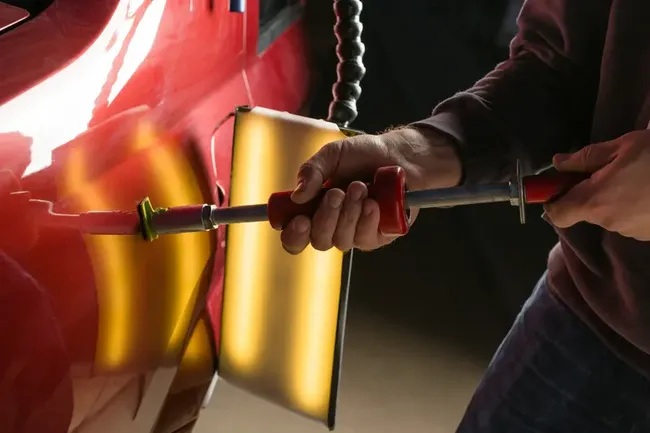
PDR stands for Paintless Dent Repair. The technician restores metal shape and, for suitable damage, preserves the existing finish. The method name does not guarantee that every dent will disappear without a trace. Paint condition, damage shape and access need assessment first. See the PDR service in Tbilisi for conditions and studio selection.
How paintless repair works
Controlled pressure changes the panel shape in small steps. Metal thickness and condition, crease location, reinforcements and the paint finish all matter. Simply saying that metal always “remembers” its factory shape does not explain the limitations of stretching or complex deformation.
An inspection light reveals low and high spots in the reflection. It provides optical surface control, rather than a promise of infrared scanning. Heating and cooling should not be described as a universal way to access a dent or as instructions for a household repair.
Tools and panel access
Specialised rods and other PDR tools are used behind the panel where access allows controlled pressure on the affected area. Glue pulling uses elements attached on the outside to pull the metal in a controlled manner. Several techniques can be combined on one dent.
Tool choice depends on the panel and defect, rather than a single universal attachment. The technician controls force and reflection to avoid creating new irregularities or damaging the finish. Owning a tool kit does not replace skill.
Reinforcements, panel edges and difficult locations may restrict the work. Necessary access or disassembly should be discussed before repair. Drilling new holes and damaging adjacent parts should not be treated as normal compulsory PDR stages.
Five practical stages
- Inspection. Check the paint, dent shape and depth, previous repairs and access to determine whether PDR is suitable.
- Surface preparation. Clean the area for reflection control and confirm the agreed scope.
- Select tools and methods. Decide whether to work from behind, use glue pulling or combine techniques.
- Gradual shape correction. Work on the metal while monitoring the surface; deep creases and stretching need individual assessment.
- Final checks. Examine the shape and finish, check the agreed areas and discuss the result with the owner.
The sequence describes a general approach, not an identical guaranteed scope or duration for every car. Price, additional access and limitations are agreed for the actual damage.
Work from behind, glue pulling and combined methods
Pressure from behind
A tool is positioned behind the damaged area to correct its shape gradually. This depends on actual access: a reinforcement or the component design may obstruct the work. The reflection is checked throughout, rather than relying on touch alone.
External glue pulling
Glued elements are attached externally to pull the deformed area in controlled steps. Paint condition and previous repainting matter when assessing risk. External access does not make this technique safe for every finish.
Combining techniques
A technician can combine internal access, glue pulling and precise correction of remaining irregularities. For an owner, the useful questions are where access is available, how the surface is monitored and what limitations have been identified.
Benefits when PDR is suitable
Suitable damage can be corrected while retaining the existing paint, without filler or repainting the area. This avoids matching a new paint colour for that repair. PDR does not restore already damaged paint or eliminate additional work where it is needed.
Cost and time depend on complexity. PDR sometimes involves fewer operations than conventional body repair, but does not guarantee savings in every case. Numerous hail dents, a sharp crease or difficult access may increase the work. A promise to repair any damage in a few hours is not justified.
Limitations, prices and choosing a repair
Damaged paint, substantial metal stretching, deep creases, panel edges or body lines and restricted access need individual assessment. Size alone does not predict success: a large shallow dent and a small sharp crease can differ greatly in difficulty.
At BESTAUTO, PDR for one panel starts from 250 ₾ and hail-damage body repair from 1800 ₾. These are starting points from the current price list, rather than a fixed charge for any single dent. Time, finish preservation and achievable results are discussed after inspection. Photographs support a preliminary assessment.
All services are available at both studios: Saburtalo and Guramishvili. Use the service page to select a studio and discuss a particular defect. For multiple dents, read our guide to hail damage repair.
What does PDR stand for?
Paintless Dent Repair. The existing finish can be retained when the damage and paint condition are suitable.
Is glue pulling suitable for a repainted panel?
Previous repainting affects the risk assessment. The finish and damage need inspection; access from outside alone is not enough to decide.
Can dent size determine the method?
Size alone is insufficient. Depth, shape, location, paint condition and access to the metal are also considered.