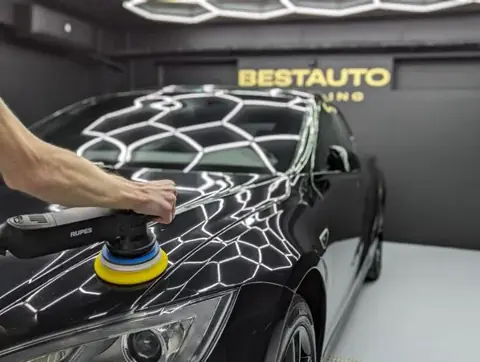
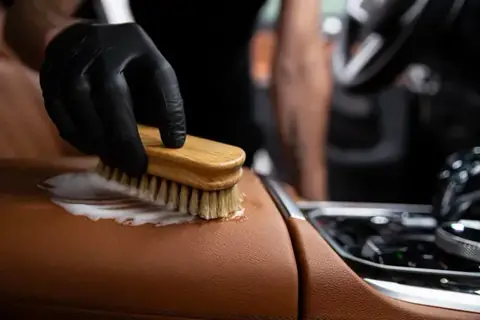
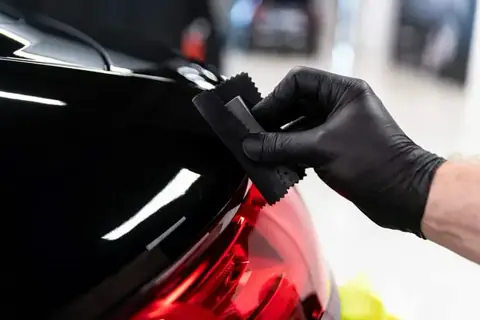
Highly recommend! Professional staff, flawless detailing, and my car has never looked better
Ceramic coating promises 2-3 years of protection and easier washing. That's true — but only if the car is washed correctly. Brush car washes, wax on top, or harsh shampoo eat the hydrophobic layer in months instead of years. Below — exactly how a ceramic-coated car wash should look, which chemistry to use, what frequency works in Tbilisi, and which mistakes shorten ceramic life.
Why ceramic can't be washed like regular paint
Ceramic coating is a very thin SiO2 or SiC film 1-5 microns thick that sits physically on the clearcoat. It's very hard (9H on pencil scale) and chemically resistant, but has vulnerabilities.
First — abrasive wear. Hardness doesn't mean "doesn't wear." Stiff brushes at automatic washes, dirty wash-bay rags, paper towels for drying — all of them leave micro-scratches on the ceramic. Unlike paint, ceramic can't be restored with abrasive polishing — it has to be re-applied.
Second — chemical attack on the hydrophobic layer. The top level of ceramic contains special groups that repel water (hydrophobicity) and dirt (oleophobicity). Alkaline shampoos (pH >9), NaOH-based products, ammonia, and some degreasers strip these groups — the film itself remains, but without its primary function. Visually the coating is there, but water starts "spreading" instead of beading — ceramic is dead in the hydrophobic sense.
Third — incompatibility with other protections. Wax, polish, silicone conditioner cannot go over ceramic. They sit on top and clog the pores of the hydrophobic layer. Result: a few weeks of shine, then permanent loss of hydrophobicity.
Wash frequency — every 10-14 days in Tbilisi
Optimal wash frequency for a ceramic-coated car in Tbilisi — every 10-14 days. Less often — dirt accumulates to a point where it's hard to remove without abrasive contact. More often — ceramic wear from any water and shampoo contact (even the correct ones) becomes visible in 1-1.5 years instead of the claimed 2-3.
Seasonal tweaks:
- Summer — once a week, since dust, pollen, insects, and birds are more active. Especially if the car is parked on the street.
- Autumn — every 10-14 days, with focus on washing off leaves and first rains.
- Winter — mandatory after every drive on the pass (where salt is), otherwise every 10-14 days.
- Spring — every 7-10 days during poplar fluff season, then standard schedule.
Two scenarios when an off-schedule wash is needed:
- Bird droppings on the body. Remove within 24 hours — the acidic digestive contents work on the clearcoat beneath the ceramic, not on the ceramic itself. Ceramic can't stop that fully.
- After a drive to the Jvari Pass or Gudauri in winter. Salt within 48 hours, or the ceramic degrades in the zones of heaviest salt contact (lower fenders, sills).
Which washes work
Three wash types are ceramic-safe, and one is categorically incompatible.
Hand wash in a studio / bay. The best option — pH-neutral shampoo, microfibre, two-bucket method (one for clean foam, one for rinsing the microfibre), drying with compressed air or soft microfibre. In Tbilisi this means "auto-detailing" quality, not a petrol-station automatic wash.
Touchless wash. Active foam applied under pressure, rinsed off without physical contact with the body. Good for weekly washes — doesn't fully replace hand wash (tar, stuck-on stains remain), but as a regular routine it works.
Water wash with your own shampoo. At home in a driveway with a garden hose, pH-neutral shampoo, and personal microfibre. Technically OK, practically — most clean-dry conditions aren't met at home, plus on a concrete driveway the microfibre picks up sand that acts as abrasive.
Brush car wash — fully banned. Stiff brushes (plastic, nylon) produce a guaranteed "web" of micro-scratches on ceramic in 2-3 washes. After that ceramic still works chemically, but visually has already degraded. This is the most common cause of premature ceramic death in Tbilisi.
Which chemistry works
Three product types are needed for washing a ceramic-coated car. We use Koch Chemie as the whitelist brand for car chemistry.
Shampoo — must be pH-neutral, labelled pH 6-8. Alkaline shampoos (with wax, "drying," "film-strip") are categorically off limits. Package should say "ceramic-safe" or "pH-neutral." Koch Chemie Nanomagic and similar professional lines work.
Degreaser for hard stains — tar, insect marks, resin. Koch Chemie has specialised formulas that work via solvent rather than alkali, safe for ceramic. Regular chemically aggressive NaOH-based degreasers can't be used.
Quick detailer or ceramic booster — after washing, to maintain the hydrophobic layer. Applied as a misted spray, buffed off with microfibre. Every 3-5 washes, not every wash.
What shouldn't be in the shampoo or care product:
- Wax (even "carnauba")
- Polymer conditioner (some "2-in-1" products)
- Silicone
- Alkali (NaOH, KOH)
- Abrasive particles (some "cleaners" contain micro-abrasive)
Microfibre and two-bucket method
Another critical part of washing — what you wipe with. On ceramic, don't use:
- Sponges with a coarse side
- Regular rags
- Paper towels
- Old microfibre with accumulated dirt
Right — fresh microfibre at 350-500 gsm density, long nap for washing and short for drying. Plus two-bucket method:
- Bucket 1 — clean foam with shampoo. That's where you take microfibre for wiping the body.
- Bucket 2 — clean water with a grit grate at the bottom. After each panel, rinse the microfibre here so sand particles settle onto the grate and don't travel back to the body.
Without the two-bucket method, any wash becomes carrying dirt from one side of the car to the other. On regular paint that leaves light scratches fixable by the next polish. On ceramic, "a polish" means replacing the coating, so the cost of the mistake is higher.
Drying — with microfibre, not towel and not "air under sun"
After washing the car has to be dried. Water left on the bonnet in Tbilisi summer dries with mineral stains (lime, salts) that are later hard to remove without aggressive chemistry. In winter it freezes into streaks.
Right drying:
- Clean dry microfibre, 350+ gsm
- Light contact, no rubbing
- Top down (so sill dirt doesn't drag onto the bonnet)
- After drying — a visual check under directed lamp for leftover marks
Compressed-air blowoff is fine for tricky spots (grilles, mirrors) — ceramic-safe. Don't dry in direct sun or with wind — that's guaranteed water spots on horizontal panels.
Wash prices in Tbilisi
Washing isn't included in the ceramic coating service and is billed separately. BESTAUTO pricing:
- 2-phase wash, sedan — 40 ₾
- 2-phase wash, SUV — 45 ₾
- 3-phase wash, sedan — 55 ₾
- 3-phase wash, SUV — 59 ₾
- Engine bay wash — 80 ₾
For a ceramic-coated car — typically 3-phase, with pH-neutral chemistry. Full pricing for all washes on the prices page. Details for the ceramic coating service on the service page.
When ceramic isn't enough and PPF is needed
Ceramic protects well against chemistry, UV, and makes washing easier. But it doesn't stop gravel and doesn't make paint impervious to serious impact. If the car regularly meets physical risk:
- Out-of-town drives on gravel
- Narrow-street parking where bikes or keys may catch the body
- Winter driving with fine gravel in slush
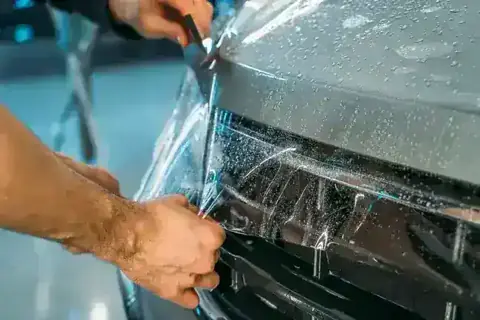
— in these cases ceramic isn't enough. Physical protection comes from PPF film — a polyurethane coat 150-200 microns. It can go under ceramic (film first, then ceramic on top of the whole body including film) or separately — only on impact zones. The second option is cheaper and covers 80% of typical cases.
FAQ
Can I wash a ceramic-coated car at a regular car wash?
Depends on the setup. Brush car wash — absolutely not; stiff brushes kill ceramic in 2-3 washes. Touchless — yes, if it's actually touchless (foam and pressurised water only, no brushes or mitts). Hand bay with proper chemistry — yes. Tbilisi has many "touchless" stations that aren't truly touchless — verify before driving in.
Which shampoo is ceramic-safe?
pH-neutral (pH 6-8), no wax, no polymer conditioner, no alkali. Package must say "ceramic-safe" or "pH-neutral." Koch Chemie Nanomagic and similar are working picks. Cheap supermarket shampoos (with wax, "2-in-1") are out — regardless of how widely they're marketed.
Do I need a boost every six months?
Not mandatory, but helpful. A boost is a repeated application of the hydrophobic layer that refreshes protection and extends ceramic life. 1-2 hours in the shop; current pricing is on the ceramic coating service page. Recommended before a heavy-load season (summer, winter) — every 6-12 months. If the car is garaged and washed gently, you can skip boosts.
What if ceramic "lost" hydrophobicity early?
First pin down the cause. If water spreads uniformly across the whole car — most likely wax from some wash or a surface dirt layer. A two-phase wash with a clay bar and stronger chemistry often brings the hydrophobic effect back. If not — ceramic is genuinely stripped, and a new layer is needed. Diagnosis at the shop — 10-15 minutes, after which it's clear whether you need a new ceramic or a boost will do.
What does a ceramic-coated car wash cost in Tbilisi?
Standard 3-phase wash — 55-59 ₾ at BESTAUTO. The wash uses pH-neutral Koch Chemie chemistry, ceramic-safe. Every month or two you can add a quick detailer or ceramic booster — that increases the wash cost by 30-50%. For daily use — standard 3-phase; for peak ceramic maintenance — quarterly extended package with booster.
Conclusion
Washing a ceramic-coated car isn't harder than a regular wash, but requires three simple rules. Right chemistry (pH-neutral, no wax), right technique (two-bucket, microfibre, no brushes), right frequency (every 10-14 days, more often in summer). Brush automatics and wax on top kill ceramic in months instead of the labelled 2-3 years.
For extra protection every 6-12 months a boost is useful — refreshes hydrophobicity and extends ceramic life. For cars under heavy physical load (gravel, tight parking) ceramic alone isn't enough — PPF film on impact zones is needed.
Key takeaways:
- Ceramic lasts long only with pH-neutral washes and hand technique
- Brush car wash and wax on top kill ceramic in months
- Wash frequency in Tbilisi — every 10-14 days, more often in summer and after passes
- Ceramic-coated car wash at BESTAUTO — from 40 ₾ (2-phase) to 59 ₾ (3-phase)
- For physical gravel protection ceramic isn't enough — PPF film is needed
Book ceramic coating or a wash at BESTAUTO via the service page form or by phone:
- BESTAUTO Guramishvili — Guramishvili Ave. 78, tel. +995 550 000 299
- BESTAUTO Politkovskaya — Anna Politkovskaya St. 51, tel. +995 550 000 199
Both studios operate Monday to Saturday, 10:00–20:00 in Tbilisi, Georgia. The wash uses pH-neutral Koch Chemie chemistry, safe for ceramic and PPF. Before washing, the technician checks the coating state and, if needed, proposes a boost to restore hydrophobicity.