Highly recommend! Professional staff, flawless detailing, and my car has never looked better
"Mobile tinting — we come to you in one hour" sounds convenient: no half day at the studio, no drive across town, the car stays with you. In practice mobile window tinting is a compromise that trades quality for convenience, and in 2-3 months the same customer often ends up at a studio removing peeling film and reinstalling. This article covers what mobile tinting is, why dust is the main enemy, how mobile and studio work differ, and why BESTAUTO operates only in a climate-controlled bay. If you still lean toward a mobile install — below is a checklist to verify whether the technician can actually deliver in field conditions.
Contents
- What mobile tinting is and where it is common
- Dust is the main enemy of the process
- No heat-shrink camera and film range limits
- No ability to give a real work warranty
- When mobile tinting actually works
- Why BESTAUTO works only in the studio
- FAQ
- Conclusion
What mobile tinting is and where it is common
Mobile window tinting (also "at-home tint" or "on-location tint") is a service where a technician comes to the customer with a film roll, squeegee, heat gun and mounting solution in a kit. Work happens in the customer's yard, office parking, or a garage bay if accessible. Average Tbilisi pricing is typically 10-20% below studio rates — savings from no rent and a faster pace (no bay prep).
In Georgia mobile tinting sits in two segments: budget (cheap Chinese film at a token price per window) and premium-on-call (rare technicians working with LLumar-tier film who genuinely know field conditions — a handful exist).
The process looks similar from outside: clean glass, cut film, apply, squeegee, heat-set with a gun. The differences sit in details the customer does not see, but they determine the long-term result.
Dust is the main enemy of the process
Window film sits on glass with micron accuracy. Between film and glass there should be nothing but a thin layer of mounting solution — no dust speck, no hair, no skin particle. A studio filters air through HVAC intake, and airborne dust is measured in tens of particles per cubic metre. In any street or garage environment — hundreds of thousands.
What that means in practice:
- Each window averages 3-5 visible points (dust specks trapped between film and glass). In a studio — 0-1.
- Those points never disappear. A week later, still there; a year later, still there.
- They are visible from inside as small glinting points on bright sun. Less obvious from outside, but at certain viewing angles — yes.
- They cannot be removed post-install — the film has to come off and be redone.
In windy weather or next to a dusty road the situation is 2-3× worse. Even in a closed garage, with the door or a window open (and technicians often work with doors open for access) wind pulls dust inside. A yard has no pressure differential to filter anything out.
A good studio pairs air filtration with an anti-static glass pre-treatment (so the glass does not attract airborne dust during install) and a humidifier that "weighs down" suspended dust. None of that exists in mobile conditions.
No heat-shrink camera and film range limits
The second technical minus is inability to use a heat-shrink camera. A heat-shrink camera is an enclosed space with heating elements where film is pre-formed to the exact glass geometry (critical for curved rear windows). Without it, cutting is done "by eye" on the glass itself with a heat gun.
What that means:
- On flat windows (windshield, front sides) — almost no issue, they are flat and the film sits correctly.
- On rear sides (slightly curved) — problems begin. Film can sit with small waves that become visible creases in a week or two.
- On rear windows (double-curved) — installing correctly without a heat-shrink camera is nearly impossible. Result is usually 3-5 film patches stitched together (seams visible) or one film with unavoidable wrinkles.
A mobile technician without a heat-shrink camera typically breaks the rear into 2-3 segments — easier to cut. But segment seams are always visible and usually start lifting within a year.
Another limit is the film range. A technician carries 2-4 film types in the kit (usually the common ones: 5%, 20%, 35% and clear 70%). Choosing a specific LLumar or LuxArmor line — no; the technician carries a generic film, often Chinese. Premium athermal films almost never appear in mobile work.
No ability to give a real work warranty
A serious studio offers an install warranty — minimum a year on workmanship, plus the film manufacturer warranty (10 years for LLumar and LuxArmor). A mobile technician cannot extend that warranty for several reasons:
1. Legally they often work as a private operator with no fixed address. Calling with a complaint 3-4 months later — nowhere: "phone out of coverage".
2. Re-installing film in field conditions is harder than the first install. Removing the damaged one, cleaning the glass, cutting new — twice the work. Few bother.
3. Risk of repeat dust. Even if the technician comes back to redo the job, a second install in the same conditions gives the same result.
4. Film without an authorised distributor. If the film did not come through an authorised LLumar/LuxArmor dealer, the manufacturer will not acknowledge it and will not issue warranty. "LLumar" printed on the roll does not make it authentic.
At a studio those points flip: fixed address, ability to redo in the same bay, authorised distributor channels, warranty-backed rework on first contact.
When mobile tinting actually works
Honest answer: rarely. But some scenarios justify it:
- Tinting one side window after a minor crash (glass was replaced, tint only needs to be restored on it). Simple operation, dust on one window is tolerable, seam with other film is not visible.
- Quick windshield film swap to pass inspection — if dark illegal film is installed and needs urgent replacement with 70%+ VLT before tomorrow's inspection. Temporary fix, quality secondary.
- Working with a premium-on-call technician who has a portable filter-tent bay. They exist, but in Tbilisi they are a handful, and they cost more than a studio.
- Tinting commercial vehicles (vans, buses) that physically do not fit a studio bay. For those, mobile is the only option.
In all other cases — especially full five or six window tints on a private car — a studio wins on every metric.
Why BESTAUTO works only in the studio
BESTAUTO does not offer mobile tinting on principle, for three reasons.
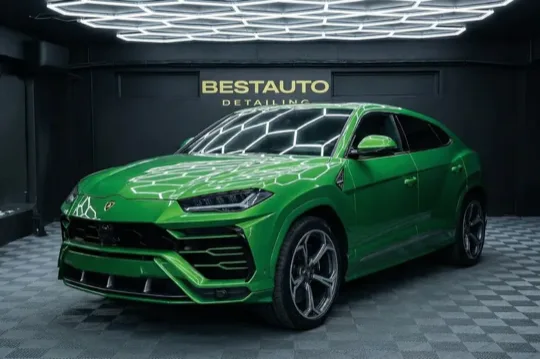
First — quality control. Our core value is the manufacturer's 5-10 year warranty on LLumar and LuxArmor film. That warranty only holds with correct install. In a clean climate-controlled bay we can guarantee no dust between film and glass, correct temperature for adhesive cure, and proper heat-shrink cutting. In field conditions we cannot, so we do not take the job.
Second — film range. The studio stocks the full LLumar and LuxArmor catalogue: standard, premium athermal, niche lines for specific tasks. Carrying all of that in a mobile kit is physically impossible, and working with a couple of generic films is below our standard.
Third — ability to redo. In Tbilisi a customer can return to the studio after a week for a free check-back, or after a year under warranty. That is part of the service. A mobile model does not support it.
That is why our pricing is built around studio work:
- Rear sides — from 130 ₾
- Front sides — from 130 ₾
- Rear window — from 160 ₾
- Windshield — from 290 ₾
The final figure is set at intake. Details on the window tinting page. Studio execution with air control, heat-shrink camera and warranty — included, not an add-on.
FAQ
How much does mobile tinting cost in Tbilisi?
Depends on the technician and film. Budget Chinese film — significantly cheaper than studio rates; premium on-call with LLumar-tier film — the opposite, 20-40% above studio (the technician offsets the lower volume). We do not publish competitor figures — market is fluid, ask the operator directly. BESTAUTO does not offer mobile tinting for quality-control reasons.
Does a mobile technician give a warranty?
A serious premium on-call technician — can give a verbal warranty, but it is rarely legally formalised. The film manufacturer warranty (LLumar, LuxArmor) only applies if the film was installed by a certified studio. Rolls bought on the market and installed by a private technician have no official warranty.
What is the visible difference between studio and mobile tint?
After a week — almost none. After 3-6 months the differences show: mobile jobs more often have visible dust specks between film and glass (especially in bright sun), occasional edge lift, sometimes film going purple (if cheap). A studio LLumar three years later looks like day one. Five years later — still does.
Can a mobile install be covered under studio warranty?
No. A studio only warrants work it did itself. If a mobile film is peeling — the studio removes it (separate operation, priced at intake) and installs new film in the studio. Details on old tint removal in the dedicated article.
Are there mobile technicians with studio-level quality?
Theoretically yes — those with a portable filtered tent and a full film range. In Tbilisi only a handful, and they usually take work on referral only. If time saving really matters, vet the technician carefully and ask to see photos of jobs 6-12 months after install.
Conclusion
Mobile window tinting sounds convenient, but in most cases it is a false time saving: 3-6 months later the customer is back on the question of redoing the job, with extra cost for removing the old film. The main enemy of mobile work is airborne dust, which cannot be filtered out in garage or yard conditions. The second factor is the absence of a heat-shrink camera — the rear window almost always ends up with defects. The third is no legal warranty and no ability to redo work.
BESTAUTO operates only in a climate-controlled studio bay in order to guarantee 10-12 year life on LLumar or LuxArmor film. Tinting starts at 130 ₾ per side window, which includes work in certified conditions and manufacturer warranty.
Key takeaways:
- Airborne dust is the main cause of mobile tinting defects
- Without a heat-shrink camera the curved rear window is installed with defects
- A mobile technician cannot offer a production-grade workmanship warranty
- 10-20% price savings flip into a redo within six months
- BESTAUTO runs studio-only to control quality and warranty
Book window tinting at a BESTAUTO studio via the form on the service page or by calling:
- BESTAUTO Guramishvili — Guramishvili Ave. 78, tel. +995 550 000 299
- BESTAUTO Politkovskaya — Anna Politkovskaya St. 51, tel. +995 550 000 199
Both studios are open Monday to Saturday, 10:00–20:00. Before installation — a free consultation on film choice and a walk-through of the climate-controlled bay where the work will happen.