Old Tint Removal — Bubbles, Peeling and the Risks

Why cheap film lasts 2-4 years, how peeling tint is removed with steam and solvent, and why rear windows with heating require special care.

If a car has 3+ year old film and you see micro-bubbles along the edges, hazy patches or a purple cast instead of black, that means the window tint is failing and it is time to remove it. Cheap Chinese film typically lasts 2-4 years, premium LLumar and LuxArmor 10-12 years. Old tint removal looks like a simple operation ("peel it off and done"), but in reality it is an hour or more of work with the risk of damaging rear-window heater grids, scratching the glass, or leaving a thick residual adhesive layer that has to be solvent-stripped separately. Below — why car window tint peels, how it is removed at a studio, why doing it yourself usually fails, and what it costs in Tbilisi, Georgia.

Contents

  • Why cheap film peels within 2-4 years
  • Three signs it is time to remove
  • Studio removal process — steam plus solvent
  • The risk to rear-window heating elements
  • Can it be done at home — usually not
  • Pricing and timing
  • FAQ
  • Conclusion

Why cheap film peels within 2-4 years

Tint film production has three key components: a polymer base, dye or metallised layer (for darkening), and a UV stabiliser. The UV stabiliser is a chemical additive that blocks ultraviolet from breaking down the rest of the film layers. In premium LLumar and LuxArmor films, the UV stabiliser works for 10+ years.

In cheap Chinese film in the budget segment, the UV stabiliser is minimal or absent — the manufacturer cuts costs because the effect is not visible immediately. In year one the film looks brand new. Within two years the dye starts breaking down from ultraviolet: black film gradually turns purple, blue turns pink, graphite goes grey-green. By year 3-4 edge lift starts and micro-bubbles form across the surface.

Additional factors accelerating peeling:

  • Severe heat (Tbilisi summers reach 55°C in the cabin) — film adhesive softens and loses its grip on the glass
  • Winter/summer temperature swings — film expands and contracts, the edge separates from the glass
  • Low-grade adhesive (acidic or substandard acrylic) — degrades from UV
  • Faulty original install (no isopropyl prep, grease left under the film)

By year 4 cheap film usually needs full replacement — driving on with it makes no sense, UV protection no longer works, and the look has gone scruffy.

Three signs it is time to remove

1. Visual colour change. Black film has gone purple or brownish. That is dye breakdown — no way back, the film no longer does its job. Beneath purple film UV protection is also gone.

2. Micro-bubbles across the surface. Not isolated bubbles in a corner (those could be an install defect), but multiple tiny bubbles or "alligator skin" across the entire glass. That means the adhesive layer has lost elasticity and is separating from the glass everywhere.

3. Edge peeling. Visible hair-thin gaps between film and glass around the perimeter. Often starts at the upper edge of side windows (where the rubber seal catches it during raising and lowering). If the gap can already be picked up with a fingernail, the film will come off completely within 1-2 months.

Additional sign — hazy film with visible "fogging" in the middle of the glass. That means a micro-gap already exists between film and glass, filled with air and dust. From outside such film looks dirty even after washing.

Studio removal process — steam plus solvent

Professional tint removal runs in three stages.

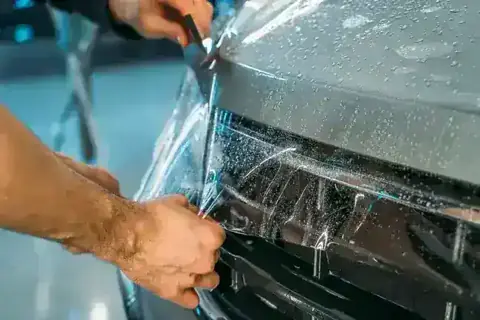
Stage 1: steam treatment. An industrial (not consumer) steam generator delivers hot steam at 100-150°C onto the inside surface of the glass with the film. Steam penetrates between film and glass, softens the adhesive layer and simultaneously heats the film into elasticity. Time per window — 5-10 minutes depending on film age.

Stage 2: careful peeling. With adhesive softened, the technician hooks the film at a corner with a blade or spatula and pulls slowly in one plane — parallel to the glass, not at an angle. Pulling at an angle tears the film into strips, and each strip has to be removed separately (time blows up 3-4×). On the rear window with heater grids, special care applies (see next section).

Stage 3: adhesive removal with solvent. A residual adhesive layer always stays on the glass — sometimes thin, sometimes a millimetre thick. It is removed with a dedicated solvent (usually isopropyl alcohol or an isopropyl plus citrus degreaser combo) on lint-free microfibre. The glass is wiped multiple times until tackiness is gone.

Final stage — wash glass inside and out, check for adhesive traces or scratches. If the customer is installing new film in the same visit, the glass stays prepped and goes straight into isopropyl cleaning plus install.

The risk to rear-window heating elements

Almost every modern car has an embedded heater grid (visible thin copper traces) on the rear window for winter defrost. These traces sit on the inner side of the glass — directly under the film. Careless removal can lift the traces along with the adhesive layer.

Tearing one or two traces — the heater keeps working but ice or condensation thaws slower at that spot. Tearing 5+ traces or damaging the contact bus bar at the edge — the rear-window heater stops working entirely. Replacing the rear window costs several hundred lari depending on car model, plus labour.

A professional technician removing rear-window film:

  • Pulls the film strictly parallel to the glass, never tearing at an angle
  • Uses lower steam temperature (80-100°C instead of 150°C) — softens the adhesive less but reduces the risk of overheating and shifting traces
  • Removes the film slower — 15-20 minutes for one rear window instead of 5-10
  • Inspects every heater trace separately after removal — checking for breaks

A street operator often removes a rear window in 5 minutes with broken traces — the customer finds out in winter when the heater fails.

Can it be done at home — usually not

The internet has guides on "remove tint with a hair dryer and ammonia in an hour". In practice most such attempts end in one of three ways:

Scenario 1: film tears into dozens of strips. Without industrial steam the adhesive softens unevenly and film comes off in pieces. Each piece has to be removed separately, total time grows from one hour to 4-5.

Scenario 2: a thick adhesive residue remains. A consumer hair dryer does not heat enough for the adhesive to come off with the film. After visible film is gone, a sticky 0.5-1 mm adhesive layer sits on the glass. Removing it needs a proper solvent plus 1-2 hours of wiping.

Scenario 3: rear-window heater grid damage. The most expensive scenario. Replacing the rear window runs into the hundreds of lari — that pays for any studio job several times over.

Self-removal makes sense only if: the film is on a side window without a heater, less than 2-3 years old (adhesive has not yet "petrified"), and you are ready to spend half a day on one window. In all other cases — go to a studio.

Pricing and timing

Old tint removal at BESTAUTO does not have a fixed line in the price list because time depends heavily on film and glass condition. The price is set at in-person inspection. Difficulty guideline:

  • Fresh film up to 2 years old — easy removal, minimal time
  • Film 3-5 years — standard steam-plus-solvent removal
  • Film 5+ years with purple and alligator skin — maximum difficulty, film crumbles

Full removal across all 5-6 windows usually takes 1.5-3 hours. If new film is being installed the same visit, removal is folded into the total job (roughly 5-7 hours in-studio for the day).

Removal alone (without new install) makes sense only if: you are selling the car and need it "bare" (sometimes a buyer requirement); you have decided to drop tinting altogether; the film is on the windshield and the next inspection means a fine. Otherwise — removal plus new install in one visit saves half a day.

Full tinting pricing is on the window tinting service page. Old film removal — separate line item, calculated at intake.

FAQ

How long does old tint removal take?

From 1 to 3 hours depending on film condition and number of windows. Fresh film 1-2 years old comes off in 5-10 minutes per window. Old 5+ year film with purple cast can take 30-40 minutes per window because the film crumbles and removes in pieces. Rear window with heater grid is always slower due to the careful work required.

Will adhesive residue stay on the glass after removal?

If a professional studio handles it — no. The final removal stage is treating the glass with a dedicated solvent until tackiness is fully gone. After that the glass looks new and new film can go on immediately. Doing it yourself without solvent — a thick adhesive layer remains that has to be stripped separately or you drive around with "sticky glass".

Does removal damage the heater grid on the rear window?

Done correctly at a studio — no. Lower steam temperature is used and the film is pulled strictly parallel to the glass to avoid catching the traces. Done in a hurry or at home with a hair dryer — risk is high, and one torn contact bus bar can take out the entire heater.

Can only part of the film be removed — say, the windshield to pass inspection?

Yes. Customers often remove only the windshield and front side windows (where the law requires 70%+ VLT) and leave the rear windows dark. Windshield removal is priced separately, usually 30-60 minutes. After that a clear athermal 70-80% can be installed and inspection passed the same day.

How long does proper film last so removal is rare?

Premium LLumar and LuxArmor film — 10-12 years without colour change or peeling. After that it is usually replaced not because of degradation but because of changing the car or wanting a new colour. Cheap Chinese film lasts 2-4 years and then mandates replacement. The price gap of premium film at install is fully offset by not having to remove and re-install every 3 years.

Conclusion

Old tint removal is not a DIY operation — a proper process with steam treatment, controlled peeling and solvent adhesive removal costs significantly less than a rear-window replacement after a botched attempt. Cheap Chinese film lasts 2-4 years, then peels, goes purple and loses UV protection — instead of yet another replacement, install premium LLumar or LuxArmor once with 10+ year warranty.

In Tbilisi old tint removal takes 1-3 hours depending on film condition and window count. If new film is installed the same visit, removal is bundled into the total job. Removal pricing is set at intake because it depends on film age, adhesive type, and whether the rear window has a heater grid.

Key takeaways:

  • Cheap film peels in 2-4 years from UV stabiliser breakdown
  • Three signs to remove — purple cast, micro-bubbles, edge lift
  • Professional removal — steam at 100-150°C plus solvent for adhesive
  • Rear window with heater needs care — fixing trace damage is expensive
  • DIY saves a small amount at the risk of hundreds in glass damage

Book old film removal or window tinting at BESTAUTO via the form on the service page or by calling whichever studio is more convenient in Tbilisi, Georgia:

  • BESTAUTO Guramishvili — Guramishvili Ave. 78, tel. +995 550 000 299
  • BESTAUTO Politkovskaya — Anna Politkovskaya St. 51, tel. +995 550 000 199

Both studios are open Monday to Saturday, 10:00–20:00. Before removal — a free in-person inspection to assess film condition and quote the work.

Google Reviews
4.8 ★★★★★ (197)
View all reviews on Google
Why Choose Our Detailing Center?
You'll love the result
  • 5 Years of Detailing Experience
    Professional wrapping of hundreds of cars of different makes and models
  • 2 Studios in Tbilisi
    Guramishvili 78 and Anna Politkovskaya 51 — choose a convenient location
  • 2,000 Satisfied Clients
    Hundreds of reviews, 4.9★ rating on Google
  • 10-Year Film Warranty
    We cover peeling, yellowing, and material defects

Order professional window tinting

Our detailing studio will handle your task with quality

Book a consultation

Choose the nearest studio
for a free consultation

Free inspection, pre-consultation and booking for main services available at both locations

BESTAUTO Guramishvili
Tbilisi, Guramishvili Ave. 78
BESTAUTO Guramishvili

Tbilisi, Guramishvili Ave. 78

+995 550 000 299
Mon–Sat 10:00 – 20:00
Enter phone in international format: +995 5XX XXX XXX
Request sent!
We will call you back within 15 minutes.
Or call us: +995 550 000 299
BESTAUTO Saburtalo
Tbilisi, Anna Politkovskaya St. 51
BESTAUTO Saburtalo

Tbilisi, Anna Politkovskaya St. 51

+995 550 000 199
Mon–Sat 10:00 – 20:00
Enter phone in international format: +995 5XX XXX XXX
Request sent!
We will call you back within 15 minutes.
Or call us: +995 550 000 199
Chat on WhatsApp
Choose your studio
Guramishvili Studio
78 Guramishvili St
Saburtalo Studio
51 Anna Politkovskaya St
Book a Free Inspection