Detailing wash in Tbilisi — what sets it apart from a regular wash

Pre-wash foam, two buckets, pH-neutral chemistry and bay drying — why a detailing wash in Tbilisi, Georgia runs over an hour and why that matters.

A detailing wash and a neighbourhood car wash in Tbilisi share the name but are two different procedures — different time, different chemistry, different results. Five minutes at a corner wash does leave the car wet and shiny, but every pass with a brush adds micro-scratches to the clearcoat that show up as a fine web under sunlight. A detailing wash is built on a different principle: the goal is not just to remove dirt but to remove it in a way the paint, ceramic or PPF can survive. Below: what a detailing wash actually consists of, where the line to a regular wash runs, and in which cases the difference becomes critical.

A regular wash — what you get in 5 minutes

The conveyor-style workflow looks like this. Car pulls in, attendant hits it with an active foam gun, waits 30-40 seconds, rinses with pressure, runs a foam brush on a stick across the body, rinses again, wipes with a large towel. Total time — 5-7 minutes. Interior is vacuum and panel wipe for extra.

What happens to the clearcoat during that:

  • A brush that already washed a dozen cars before yours carries sand and metallic brake dust from the previous customers
  • Those particles act like sandpaper on contact — leaving thin linear marks on the clearcoat
  • One towel for the whole car transfers dirt from sills and wheel arches to the hood and fenders
  • Chemistry is often a universal alkaline — cheaper per litre but strips ceramic and softens fresh PPF

Visually the car looks clean after. But under direct sun on a dark colour, after 6-10 cycles you see the swirl-mark web — thousands of microscopic scratches going one direction, like a brush trail. On light cars it is less visible, but the damage is identical. That is the real cost of the time saving.

Detailing wash — the actual steps

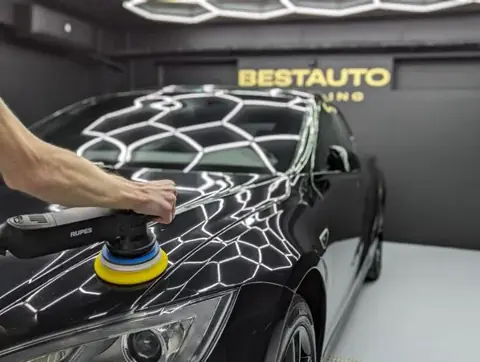
A detailing wash in Tbilisi is built on a different principle: minimise physical contact with a dirty surface and use chemistry designed for automotive materials, not for toilets. At BESTAUTO the procedure takes 60-90 minutes on a sedan and consists of steps, each with a function.

Pre-wash with active foam. A foam cannon lays a coat of foam over the dry or lightly pre-wet body. Foam works for 3-5 minutes — chemistry softens and lifts the bulk of dirt (dust, insects, light deposits) off the paint. Nobody touches the body with hands at this stage. Rinsed with 100-120 bar pressure from at least 30 cm away.

Wheel wells and rims separately. A separate acid or alkaline compound (depending on contamination) and a separate brush for the rims. This is the dirtiest area of the car — if you wash it with the same mitt you use on the hood, the hood is ruined. A regular wash merges the two.

Two-bucket method. The main element of a detailing wash. Two buckets: one with shampoo solution, the other with clean water. Plus a microfibre Plush wash mitt with long pile.

The sequence: mitt into soapy bucket → one panel from top to bottom → mitt into clean water bucket, grit pulled off on a grit-guard grid at the bottom → back to soapy → next panel. Dirt stays in the clean-water bucket and never returns to the paint. No brush, no towel, no single sponge for everything — only mitt pile that effectively glides over the paint with a soap film acting as lubricant.

Specialised chemistry. Shampoo — pH-neutral (6.5-7.5), no aggressive alkalis. That is critical: a pH 10+ compound eats through the hydrophobic effect of ceramic in a handful of cycles and softens the PPF adhesive layer. At BESTAUTO we use Koch Chemie — a German brand with dedicated ceramic and PPF lines.

Rinse and bay drying. The car is rinsed with osmosis water (no salts or minerals — no spots after drying) and dried either with a blower or fresh microfibre Plush inside a closed dust-free bay. Not outside in the wind, where particles settle on wet paint immediately.

Detailing wash chemistry — why pH matters

Every car shampoo is characterised by its pH. Closer to 7 means more neutral and safer for the coating. Alkaline compounds (pH 9-12) are more aggressive, better on old grime, but damage clearcoat, ceramic and PPF. Acids (pH 3-5) are used on rims and mineral deposits but also strip the hydrophobic layer.

Practical consequences for the car:

  • On typical alkaline chemistry a ceramic coating loses hydrophobic behaviour in 3-4 washes — water stops beading
  • The PPF adhesive layer softens under alkali — after six months of such washes you see lifted edges on the bumper and arches
  • Automated tunnels with rotating brushes add mechanical impact to alkali — the swirl web forms over 10-15 procedures
  • On unprotected clearcoat alkali does not destroy it instantly, but progressively removes wax and factory sealant, accelerating oxidation

A detailing wash with pH-neutral shampoo and a mitt works as a mild scheme: chemistry lifts dirt at the pre-wash stage, physical contact is kept to a minimum, and whatever stays on the surface is carried off with a soap film without friction.

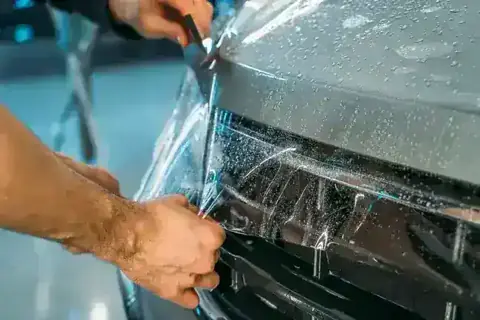
On a car with PPF, wash chemistry must be pH-neutral and solvent-free — otherwise the film yellows at the edges within a year. More on what the film itself demands — on the page about PPF paint protection film.

When the difference between the two becomes critical

Not every car needs a detailing wash. If you drive a white 10-year-old commuter and plan to sell it this year, a neighbourhood wash changes essentially nothing. But there are scenarios where the approach directly breaks the owner's budget.

A car with a ceramic coating. Ceramic runs from 500 ₾ on the body and lasts 2-5 years with proper care. Three washes in an automated brush tunnel with alkaline chemistry, and the hydrophobic effect is gone — the coating becomes a decorative layer with no function. Ceramic money — wasted.

A car with PPF on the hood and bumper. Polyurethane film is sensitive to chemistry. A front package starts at 2500 ₾, a single hood sheet at 800 ₾. A year of alkaline washes, and the film yellows at the edges and starts peeling — everything needs redoing.

Dark colours (black, dark blue, metallic grey). Swirl webs show on them under any sunlight. After 20-30 regular washes the owner feels the car has aged dramatically, when the issue is just brush marks. Abrasive polishing fixes it, but that is +690 ₾ to the budget.

A brand-new car in the first 1-2 years. Factory clearcoat is particularly vulnerable in this period — not fully cured yet. Aggressive washing at this stage cuts coating service life by 3-5 years.

What a detailing wash in Tbilisi costs and what's included

BESTAUTO prices a detailing wash by vehicle class and number of phases. Current numbers:

  • 2-phase wash, sedan — 40 ₾
  • 2-phase wash, SUV — 45 ₾
  • 3-phase wash, sedan — 55 ₾
  • 3-phase wash, SUV — 59 ₾
  • Engine bay wash — 80 ₾

2-phase means pre-wash active foam + hand wash with the two-bucket method, rinse and drying. 3-phase adds a protective nano-shampoo or wax booster that gives a temporary hydrophobic effect for 3-4 weeks. Engine bay is priced separately, with electronics protection and steam cleaning.

The final figure for your car is set on inspection: size, soiling level, presence of ceramic or PPF (these need a shampoo with matching pH). Full pricing — on the detailing car wash service page.

How to tell a real detailing wash from the label

Plenty of washes in Tbilisi call themselves "detailing" but effectively do what any neighbourhood wash does — just more expensive. A few signs that tell where the real process is and where the label is repriced.

  • They ask about protective coatings before starting. If you say "ceramic" or "PPF on the hood", the studio should pick a dedicated shampoo. If the answer is "same wash as always" — not detailing.
  • A real foam cannon with its own reservoir. Not a spray gun with thin foam, but a full foam cannon producing thick fluffy foam that holds on the body 3-5 minutes.
  • A Plush mitt, not a brush or a sponge. A long-handle brush means regular wash with micro-marks. A synthetic sponge means the same with less pile.
  • Two buckets, grit guard on the bottom. Visible standard. A single bucket sends grit straight back onto the paint.
  • Drying inside a closed bay. The car does not go straight out into the wind after washing. If it does — the whole effort is lost at the last step.
  • Named chemistry. Koch Chemie or another professional German/European auto-chemistry brand with a clear composition and pH on the label. The answer "universal auto chemistry" = bulk-bag budget compound.
How often to do a detailing wash

In Tbilisi conditions (dust, summer heat, mountain-road salt in winter) the optimum is every 10-14 days for a car with no protective coatings and every 2 weeks for ceramic or PPF. More often — no point; less often — dirt settles into the clearcoat pores and the next wash demands more chemistry and effort.

Between detailing washes a quick brush-free wash (foam and rinse only) is acceptable too — it lowers the average bill. But avoid automated tunnels with rotating brushes and "wash-vacuum" stations at gas stops where the brushes are shared.

At 35-40°C in summer, washing under direct sun is not advisable even in a detailing context — the shampoo dries on the body within a minute and leaves spots. Professional studios therefore always operate inside a closed or shaded bay with controlled temperature.

FAQ
How does a detailing wash differ from a regular wash in one sentence?

A regular wash aims for "car is clean in 5 minutes"; a detailing wash aims for "car is clean without new scratches on the paint in 60-90 minutes". The difference is in chemistry (pH-neutral shampoo vs universal alkali), tool (microfibre mitt vs foam brush) and approach (two-bucket method vs one sponge for everything). On a ceramic- or PPF-coated car the difference is in coating service life.

Can a ceramic-coated car be washed at a regular wash?

Physically yes, but the coating degrades fast. Alkaline chemistry strips the hydrophobic layer in 3-4 cycles; brushes add micro-scratches on top of the ceramic. Ceramic money (from 500 ₾) is spent in vain — either wash at a detailing studio or skip ceramic and stick with plain wax.

Why does a detailing wash take over an hour if a regular one is 5 minutes?

Most of the time is pre-wash (foam dwells 3-5 minutes), two-bucket method (panel by panel, at least 20-25 mitt passes across the body) and bay drying. It just cannot go faster — speed up and the procedure loses its point. A regular wash is faster because it skips all these steps.

Can you do a detailing wash at home?

Technically yes. You need a foam cannon, two buckets with a grit guard, a microfibre Plush mitt, a pH-neutral shampoo, osmosis water for the final rinse, and shade above the car. In practice most owners try it 2-3 times and give up — too much equipment and time. In winter it is barely feasible without a heated bay.

Is drying after rinsing necessary, or can I let the car air-dry?

Drying is mandatory. Even tap water contains minerals and salts that leave white spots on the paint after evaporation — those then need polishing compound to remove. A detailing wash uses either a blower or fresh microfibre to soak water off. Leaving a car to air-dry outside guarantees streaks.

Conclusion

A detailing wash is not a premium wrapper around a regular service — it is a different technology with a different result. A regular wash aims for a clean car in 5 minutes; detailing aims for a clean car without clearcoat, ceramic or PPF damage. The difference shows over 10-20 cycles: on a regular wash a dark car grows a swirl-mark web, ceramic loses its hydrophobic behaviour, PPF yellows at the edges. In detailing none of that happens — the procedure was designed around preventing it.

For an unprotected light-coloured car a regular wash is acceptable. For ceramic, PPF, dark colours and new cars a detailing wash pays back over a year's horizon — otherwise redoing polishing or repairing coating costs more than the wash savings.

Key takeaways:

  • Regular wash — 5 minutes, brush, universal alkali, risk of micro-scratches
  • Detailing wash — 60-90 minutes, foam, Plush mitt, pH-neutral shampoo
  • 2-phase sedan detailing wash — 40 ₾, 3-phase — 55 ₾, SUV +5 ₾
  • On ceramic and PPF a regular wash destroys the coating in 3-4 cycles
  • On dark cars 20-30 regular washes create a swirl-mark web

Book a detailing wash at BESTAUTO via the form on the service page, or call whichever studio is closer in Tbilisi, Georgia:

  • BESTAUTO Guramishvili — Guramishvili Ave. 78, tel. +995 550 000 299
  • BESTAUTO Politkovskaya — Anna Politkovskaya St. 51, tel. +995 550 000 199

Both studios are open Monday to Saturday, 10:00–20:00. On inspection the technician identifies which wash phase matches the condition of the car and the type of coating.

Why Choose Our Detailing Center?
You'll love the result
  • 5 Years of Detailing Experience
    Professional wrapping of hundreds of cars of different makes and models
  • 2 Studios in Tbilisi
    Guramishvili 78 and Anna Politkovskaya 51 — choose a convenient location
  • 2,000 Satisfied Clients
    Hundreds of reviews, 4.9★ rating on Google
  • 10-Year Film Warranty
    We cover peeling, yellowing, and material defects

Order professional detailing

Our detailing studio will handle your task with quality

Book a consultation

Choose the nearest studio
for a free consultation

Free inspection, pre-consultation and booking for main services available at both locations

BESTAUTO Guramishvili
Tbilisi, Guramishvili Ave. 78
BESTAUTO Guramishvili

Tbilisi, Guramishvili Ave. 78

+995 550 000 299
Mon–Sat 10:00 – 20:00
Enter phone in international format: +995 5XX XXX XXX
Request sent!
We will call you back within 15 minutes.
Or call us: +995 550 000 299
BESTAUTO Saburtalo
Tbilisi, Anna Politkovskaya St. 51
BESTAUTO Saburtalo

Tbilisi, Anna Politkovskaya St. 51

+995 550 000 199
Mon–Sat 10:00 – 20:00
Enter phone in international format: +995 5XX XXX XXX
Request sent!
We will call you back within 15 minutes.
Or call us: +995 550 000 199
Chat on WhatsApp
Choose your studio
Guramishvili Studio
78 Guramishvili St
Saburtalo Studio
51 Anna Politkovskaya St
Book a Free Inspection