The best service! The work was done within the agreed time frame! The best professionals! Good luck!
Hazed headlights aren't only a cosmetic defect. With yellowed polycarbonate, light output drops by 40-60%, low-beam gives scattered glare, and on dark out-of-town roads around Tbilisi that's a safety issue. The good news — in most cases headlights can be brought back to order with polishing for 150 ₾. The bad news — there's a point where polishing no longer helps and replacement is the only option, which depending on model costs from 400 to several thousand lari per pair. Three tests below to place your car, and what to do in each case.
Why headlights haze — polycarbonate physics
Modern headlights are made of polycarbonate — a tough transparent plastic coated at the factory with a thin protective UV layer. That layer lasts 5-8 years, then starts degrading under ultraviolet and chemicals (winter salt, exhaust, tar from roads). Dust, small gravel, and insects add mechanical micro-scratches.
The process runs in three stages:
- First — hazing of the outer coating. Polycarbonate inside is still clear, but the protective layer has started yellowing and matting. Visually the lens looks "dirty" even when clean.
- Second — deep polycarbonate yellowing. UV has broken through the protective layer and works on the plastic itself. Colour shifts evenly; light passing through shows a yellow tint from within.
- Third — cracks, internal haze, structural breakdown. Polycarbonate no longer recovers; part of the material has physically degraded, not just optically.
Polishing works on stages 1 and 2 — removing 20-100 microns of the outer yellowed layer and exposing clear material underneath. On stage 3 polishing is useless: haze lives inside the material, cracks run through the thickness — you physically can't reach them.
Three tests to tell polishing from replacement
Figuring out which one your headlight needs takes 5 minutes in a garage or on a parking forecourt under a lamp.
Test 1: visual check with lights off.
Look at the headlight from different angles. If hazing is even and only outside (the plastic shows sandblast-like marks, the lens is matte across the whole surface) — stage 1, polishing will definitely help. If the plastic is clear outside, but the colour inside the headlight is clearly yellow or brownish — stage 2, polishing will help but may need a deeper pass with UV coating renewal.
Test 2: finger check.
Run your finger across the lens with the lights off. If the surface feels rough, leaving a "sandpaper" sensation — that's the outer layer, it comes off with polishing. If the surface is smooth but haze still shows — haze is deeper, polishing will help partially.
Test 3: light from inside.
Turn the headlights on in the dark. If high-beam gives an even, strong beam without scatter — all is well; polishing is either unnecessary or purely cosmetic. If low-beam gives "milky" glow (light scatters inside the headlight) — there's a problem inside the plastic or reflector. If the reflector is intact — polishing will help. If the reflector has flaked, hazed, or rusted (common on 10+ year cars) — the headlight can't be saved, only replaced.
When headlight polishing still works — and what it does
Headlight polishing is an abrasive procedure similar to body polishing but specialised. The sequence:
1. Masking the paintwork around the headlight — abrasive leaves matte marks that would otherwise need cleanup.
2. Surface degrease.
3. First pass with coarse abrasive (600-800 grit) — removes the yellowed and damaged layer.
4. Sequential passes with finer abrasives (1000, 1500, 2000, 3000 grit) — level the surface.
5. Finishing compound with a foam pad — restores clarity.
6. Applying a new UV protective layer (specialised lacquer or ceramic) — the critical step. Without it polycarbonate is left unprotected and hazes again within 1-2 years.
Result — the lens is clear outside and through, light output restored to 80-95% of factory. Price at BESTAUTO — from 150 ₾ per lens; full pricing on the car polishing page.
Important: a studio doing polishing without the final UV coat is saving time and charging for a temporary result. In a year to 18 months the headlight will haze again — faster than if left alone, because the protective layer has already been removed. When booking car polishing, confirm UV coating is included.
When polishing won't help — only replacement
Four situations where polishing is useless or even harmful.
First — cracks in polycarbonate. Through a deep scratch or crack, UV and temperature drive micro-delamination in the polycarbonate. Abrasive cannot "cut" the crack — it runs into the material's thickness. Polishing only removes the outer layer around the crack and makes it more visible.
Second — through-yellowing. Stage 3 — yellow colour even through the full thickness; polycarbonate has degraded to the base. Abrasive removes 100-200 microns off the top, but the material below stays yellow. Result: the headlight is still yellow, just thinner and with less buffer for the future.
Third — reflector damage. Inside the housing, the reflector flakes over time, especially if moisture entered the assembly. The lacquer peels off, rust spots appear, aluminium darkens. No external polishing addresses this — the reflector isn't detachable inside the headlight.
Fourth — fogging inside the headlight. Persistent condensation inside means the seal is broken. External polishing won't fix it — fogging continues, interior components corrode over time. The fix: seal it (possible if damage is localised) or replace.
In these cases replacement is the only option. Replacement price depends heavily on the model and is quoted at a dealer or breaker. On budget 10+ year cars a new headlight is materially pricier than polishing, on premium cars with LED matrix or laser — tens of times pricier. Aftermarket and breaker units are usually cheaper than OEM, but quality varies widely. When replacement is expensive, looking for a well-preserved used headlight at a breaker often makes sense.
Prices in Tbilisi: polishing vs replacement
For a budget comparison:
- Headlight polishing — from 150 ₾ per lens at BESTAUTO. Full pricing on the polishing page.
- Second-hand original replacement — cheaper than new OEM, but several times pricier than polishing.
- New original replacement — several-fold to tens-fold pricier than polishing, model-dependent. Premium cars with LED matrix or laser — the most expensive option.
- Aftermarket (non-original) replacement — usually 20-40% of the original's price. Quality varies wildly, from "near-original" to "holds a year then leaks."
Simple math: if a 150 ₾ polish buys another 2-3 years of lens life and replacement runs ten times that — polishing pays off many times over. But if the lens is already in stage 3 or cracked, polishing is 150 ₾ thrown out: the replacement is coming anyway.
How to extend headlight life after polishing
After polishing and a fresh UV layer, the protective window is 2-3 years. Three measures help push it closer to the maximum:
- No brush washes. Brush stations lay down fine scratches on the fresh UV layer — it starts degrading faster.
- Shade or garage parking. UV is the main enemy of polycarbonate. A car in direct sun 8 hours a day loses UV protection twice as fast as one kept in a garage.
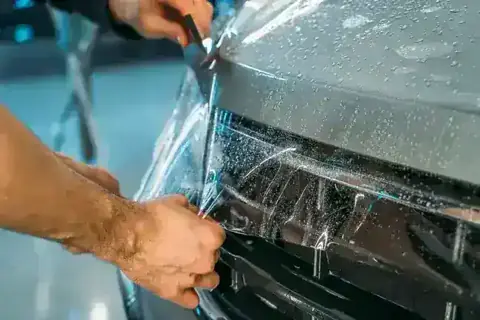
- PPF film on headlights. A clear 150-200-micron film that physically protects the lens from gravel, insects, and direct UV. Costs significantly more than polishing but gives 10 years of protection. On expensive headlights this is often a smart investment — wrapping two lenses runs cheaper than replacing one.
At BESTAUTO, film on the headlights goes on after polishing (first restore clarity, then seal with protection). The film is visually transparent and does not change the colour or brightness of the light.
FAQ
How many times can headlights be polished before replacement?
2-3 times safely. Each procedure removes 50-150 microns of material; factory wall thickness is 3-5 mm. After 3 polishes the lens is thinner, loses some stiffness, and the UV layer has little room left even with reapplication. Practical ceiling: 4-5 full polishes before new problems appear.
What happens if I polish without a final UV coat?
Clarity returns for a few weeks, then hazing comes back — faster than before. The abrasive strips the factory protective layer, and if you don't apply a fresh one on top, bare polycarbonate sits under direct UV. Typically a lens without protection hazes in 6-12 months vs 5-8 years with proper protection. Always confirm UV coating is part of the service.
Can I polish headlights DIY at home?
Technically yes, DIY kits exist (toothpaste, sandpaper of different grits, finishing compound). Practically — risky: without practice it's easy to end up with "hologram" polycarbonate, to leave scratches from coarse abrasive, or simply to skip final protection and get a hazed lens in a year. A cheap DIY kit makes sense only if you plan to replace the headlights within a year and just want better low-beam vision in the meantime.
If the headlight is fogging from the inside, can external polishing fix that?
No. Fogging means broken seal (housing crack, gasket damage, post-repair defect). Moisture keeps entering, interior components corrode. External polishing is cosmetic and doesn't address the root. The fix: disassemble and reseal (difficult, often not worth it) or replace.
What does headlight polishing cost in Tbilisi?
At BESTAUTO — from 150 ₾ per lens. The price includes abrasive work and the final UV protection. Per pair the price is typically from 290 ₾ with a small pair-work discount. Exact figure — after in-studio inspection: if the headlights are in heavy stage 2 with deep yellowing, work takes more steps and the price may be higher.
Conclusion
The choice between headlight polishing and replacement isn't about budget — it's about material condition. If polycarbonate has degraded only on the surface (stage 1 and early stage 2), polishing restores 80-95% of light output and costs 150 ₾ per lens. If yellowing is through-thickness, interior damage, cracks, or reflector issues — polishing is useless and saving on it turns into money spent with no result.
Three tests (visual, tactile, light) sort out the state in 5 minutes. After polishing, wrapping the headlight with PPF extends protection from 2-3 years to 10 and on premium optics saves replacement cost.
Key takeaways:
- Headlight polishing works for polycarbonate degradation down to ~3 mm depth
- Stages 1-2 (external yellowing) — polishing at 150 ₾; stage 3 — replacement only
- Without a final UV coat, polishing lasts a year, not 3
- A new headlight replacement is 3-40x more than polishing, model-dependent
- PPF film on headlights after polishing gives 10 years of UV and gravel protection
Book headlight polishing at BESTAUTO via the service page form or by phone:
- BESTAUTO Guramishvili — Guramishvili Ave. 78, tel. +995 550 000 299
- BESTAUTO Politkovskaya — Anna Politkovskaya St. 51, tel. +995 550 000 199
Both studios operate Monday to Saturday, 10:00–20:00 in Tbilisi, Georgia. Before the procedure — an in-person inspection to identify the degradation stage and whether polishing will do or a search for replacement parts is needed.