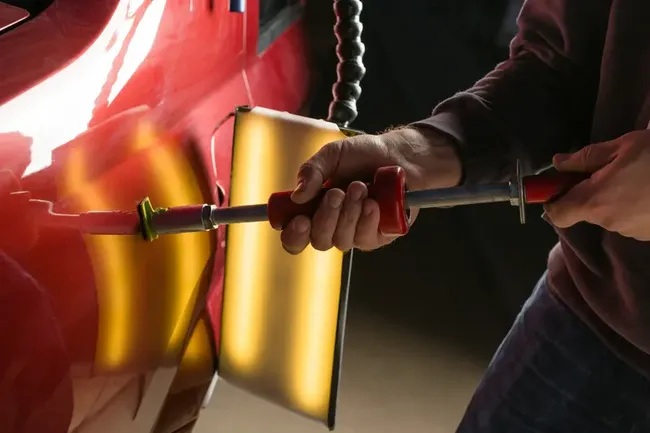
PDR means Paintless Dent Repair. It corrects the shape of a suitable metal panel while retaining its existing paint finish. Where the damage allows this approach, the area does not need filler and repainting. The term PDR does not mean that every dent can be removed without a visible trace.
This guide helps you choose a repair approach. For technical differences between tools, see our PDR methods guide. For numerous body dents, read about repair after hail damage. The studio offer and assessment are on the paintless dent repair service page for Tbilisi.
PDR or repair with repainting: what determines the choice?
First establish what is damaged: the metal shape alone, or the finish as well. When paint is intact, PDR may help retain it. Correcting the shape does not restore chipped, cracked or peeling paint. After an impact, other affected parts also need assessment; the appearance of one dent does not describe all the damage.
Repair involving refinishing can include damage assessment, cleaning and preparation, surface correction, paint application and finishing work. The vehicle condition determines whether filler, repainting or panel replacement is needed. These are appropriate solutions in suitable cases; PDR does not automatically replace them.
Compare the achievable result, work involved, cost and time. Avoiding repainting can remove some work stages, but difficult access, deep deformation and many dents also take time. A claim that one method is always faster and cheaper does not help choose the repair for a particular car.
How the shape is corrected without new paint
Where suitable access behind the panel exists, the technician works with specialised tools from inside. External glue pulling may be used when the finish permits it. These act differently: a glue tool does not push metal from behind. A combination may be considered for a particular dent.
The shape is corrected gradually while its reflection is monitored. Panel construction and access affect suitability. I-CAR guidance on PDR access advises against drilling new access holes or damaging other parts, and notes the risk of damage to the finish. This is a technical limit, rather than a promise of an identical procedure for every vehicle.
Benefits when PDR is suitable
- Retaining the finish. When repair is possible without painting, the existing paint stays on the panel. A previously repainted panel does not become factory paint.
- No new colour matching. Without new paint application, there is no need to match a new colour to adjacent panels. The achievable shape still needs separate assessment.
- Fewer stages involving paint materials. A suitable dent may be repaired without applying filler and paint. Price and time depend on the damage itself.
- Potential use on different metal panels. A door, fender, bonnet or roof may be a candidate for assessment. Location and construction prevent an identical result being guaranteed for every panel.
Retaining paint can matter to the owner and a future buyer. The repair method alone does not guarantee resale value, an invisible repair or a perfect result.
Which dents should you show a technician?
Size is only one factor. A small dent with a sharp crease can be more difficult than a larger, smooth deformation. Depth, shape, metal stretching, finish condition, previous repairs and access behind the panel all matter.
| Situation | What to assess before choosing a repair |
|---|
| A door ding or hail dent with apparently intact paint | PDR suitability depends on shape, depth and access. Intact paint does not guarantee repair of every dent. |
| A deep or large dent, sharp crease or body line | Discuss complexity and the achievable result; another body repair may be needed. |
| Chips, cracked paint or scratches | PDR corrects the shape, not damage to the finish. These tasks are agreed separately. |
| A previously repainted or repaired panel | Assess finish condition and whether the selected method, including glue pulling, is suitable. |
| A deformed plastic bumper | Do not treat it as PDR on a metal panel: the material and restoration method need separate assessment. |
A door impact, hail or a falling object describes the cause, not confirmed suitability for PDR. Avoid household heating or pulling attempts before inspection: changes to the metal or finish can complicate further work.
Four assessment and repair stages
- Assessment. Inspect the dent, finish and access. Discuss the method, limits and expected result, then agree the scope, price and estimated time.
- Preparation. Clean the surface so its reflection can be checked. Discuss access requirements and any additional disassembly before work.
- Shape correction. Choose work from behind, glue pulling or a combination, and correct the deformation gradually.
- Check. Examine the surface, finish and agreed areas, then explain the result and possible limitations to the owner.
Photographs from different angles help with a preliminary discussion. The method and full repair scope are decided after inspecting the vehicle: photographs do not always reveal paint condition or access behind the panel.
PDR prices and the next step at BESTAUTO
The current BESTAUTO offer gives PDR on one panel from 250 ₾ and hail-damage body repair from 1800 ₾. The panel starting price is not a fixed charge for any individual dent. The quote depends on the damage, number and complexity of dents, finish and access.
All services are available at both studios: Saburtalo and Guramishvili. Compare the PDR service details with current prices, then choose a studio for assessment. Time and expected results are agreed for the vehicle, without a universal promise to restore every kind of damage.
Does PDR remove scratches?
No. It corrects the metal shape. Scratches and paint damage are discussed as separate tasks.
Can a repair be assessed by dent diameter alone?
No. Depth, creases, the finish, previous repairs and access also matter. Photographs provide preliminary information, not a final quote.
Is PDR needed after every minor accident?
The decision follows assessment of all damage. A cosmetic dent and damage affecting the structure or adjacent parts require different approaches.