Timing depends on the paint system and drying process. Check coating readiness and the defects first, then agree on correction and any additional protection.
Polishing after body repair can reduce finishing marks and improve reflections. The need depends on the panel: repainting alone does not prescribe deep correction of the entire car. Start with when and how the surface was painted, and the problem you want to address.
Correction possibilities are determined after coating assessment.
When can you polish after repainting?
Ask the painter for the paint system, application date, drying method and permitted next operations. Those conditions determine polishing readiness. A surface being dry to touch is not the same as being ready for correction; do not test it yourself with heavy rubbing.
The PPG D8178 technical sheet, for example, distinguishes dust-free, handling and polishing stages. Drying and cooling matter for that system. Its timings cannot be transferred to a different paint, and one waiting period does not fit every car.
If the material or drying process is unknown, begin with the body shop. Permission for finishing polish does not by itself set the installation date for every coating or film.
Which defects need assessment?
Visible condition
What to assess
Holograms and fine marks
Whether suitable finishing correction can help
A dust nib or pronounced texture
Its location and whether separate levelling is needed
Colour mismatch, peeling or missing paint
Refinish quality and possible repair
Surface contamination differs from an inclusion beneath clearcoat. Pronounced orange peel may call for a separate operation and coating assessment, rather than routine polishing. Added gloss does not fix colour mismatch, chips, corrosion or peeling.
Inspection, preparation and a test spot
Assessment considers repair history, panel material, edges and adjacent areas. Body polishing is selected after cleaning and inspection. Depending on its type, a gauge measures total coating or individual layers; a single reading does not guarantee a safe correction depth.
Cleaning, contamination removal and degreasing must suit fresh paint and product instructions. Strong chemicals or mechanical cleaning are not automatically suitable for a recently repaired panel. A test spot helps select the compound, pad and method; edges and sensitive materials need protection.
Correction scope and checking the result
A finishing pass may be enough, while more visible traces may require a different sequence. The aim is to reduce suitable defects within agreed limits. Multiple stages and correction of neighbouring panels are not mandatory after every repair; see the light versus intensive correction guide.
Inspect the same area under suitable light afterwards and discuss remaining marks and the agreed scope. Our before-and-after guide explains how clearer reflections differ from new paint. Polishing does not reverse repair history or guarantee factory condition.
Ceramic and PPF on a repaired panel
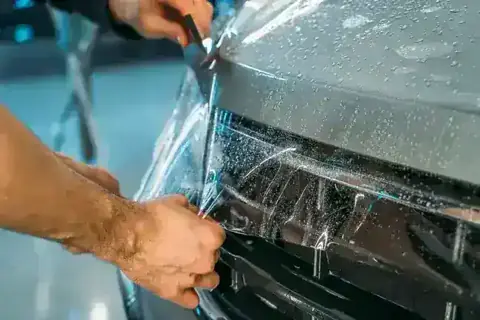
Ceramic coating and PPF address separate protection and maintenance needs. Film installation on repainted surfaces requires checks of compatibility, condition and substrate readiness. The 3M Protection Wrap Film guide requires a recently applied finish to cure according to the paint manufacturer's instructions before installation.
Agree polishing, protective coating and film dates separately. A freshly repainted front panel is not automatically ready for film. If PPF and ceramic are selected, discuss preparation and film installation first, followed by compatible coating on the intended surfaces; there is no compulsory bundle.
Care after repair and correction
Get the body shop and studio's instructions for when and how to wash, suitable products and maintenance of any protection. Remove contamination with a compatible method, avoiding dry grit rubbing and dirty towels. Assess new marks first; another abrasive correction is not the automatic response to every defect.
Price and consultation in Tbilisi
BESTAUTO body polishing starts at 690 ₾. That body offer is not a quote for every individual repainted panel. Body ceramic starts at 500 ₾ and the promotional polishing/ceramic combination at 990 ₾; paint readiness and scope still need separate agreement. See current prices.
Common questions
How many days after painting can a panel be polished?
There is no universal number. Check the paint system, drying process and permitted operation with the painter using its technical sheet.
Must every polish wait for full cure?
Follow the specific system's polishing requirements. They can differ from film-installation requirements; one rule for every material is unsuitable.
Can polishing fix colour mismatch or dust under clearcoat?
It does not correct colour mismatch. The dust defect's location and permitted treatment need assessment; removal of every inclusion cannot be promised.
Can PPF be installed immediately after polishing?
Only after checking paint readiness and the selected film's conditions. Having polished the panel does not replace that check.
Does repairing one panel require polishing the whole car?
Condition and purpose determine scope. One panel or selected areas may suffice; adjacent panels are discussed where needed.
All services are available at both studios: Saburtalo and Guramishvili. Discuss polishing after repair: share the painting date, panels, materials and painter's recommendations. Photos help start the conversation; final scope is agreed after assessment.
Real reviews from our clients
Reviews after polishing
Clients notice what matters to us
Customer reviews on Google across both studios
Google MapsPolish + ceramic
The visible wear and tear that was on the body was impressively refreshed … I appreciate that in the services, they included one extra panel sanding and polishing, on the house … The staff is attentive, cares about its clients and provides comprehensive explanation during consultation before starting the works…
After polishing, the body looks like new — a deep gloss appeared and the light scratches are gone. After the interior cleaning the cabin is fresh and spotless. The work was done well, carefully and within the agreed deadline.
This is a place where the quality of the work is worth more than the price. I brought two cars — one for polishing, the other for interior cleaning — and I'm very glad I found this place. They are true professionals.
They talked everything through clearly, pointed out the spots where polishing might not help, and gave me a discount on the interior cleaning. Everything was done within the agreed deadline and the car looks great. Prices are lower than at the nearest competitors.
Asked to polish a car with a lot of minor scratches … Guys made it great, even polished plastic details, cleaned my interior and even dismounted roof top handle bars to polish roof completely. Thanks for great result and the most important thing - they did it in discussed time frame…
At first, I tried with my first car, which was in terrible condition with seats and interior, totally spoiled with dampness extreme moisture & bad odor djrimg tranist from US. I was really surprised after seeing the exceptional results … i brought my second car for detailed cleaning, polishing, and ceramic coating … In terms of pricing, they are also very reasonable.
After the paint on my 2023 Subaru Forester was damaged due to dog scratches, I needed a place to polish and re-apply the ceramic coating … A week later, my car looked almost brand new, with hardly any trace of scratches, and the damaged areas were perfectly matched…