Polishing an old car — when it works and when it hurts

Polishing a 7-15-year-old body — where it works, where it's useless, and where it's risky. How the technician decides whether to take the car on.

Polishing an old car at 7-15 years old is a question without a universal answer. On one car of a given model year polishing delivers the same result as on a three-year-old: even colour, deep shine, swirl-mark web gone. On another of the same model, polishing only brings the next repair closer — the clearcoat is thin, edges are worn, the next abrasive pass will break through to primer. The difference lies in storage, driving style, and body-repair history. Below: how to honestly assess whether your old car is worth polishing, when the result is excellent, and when to walk away.

What happens to clearcoat over 10 years

Factory clearcoat on mass-segment cars measures roughly 100-120 microns out of the plant. Every wash, every polish, every year of sun and rain thins that layer: dust and detergents act as a very mild abrasive, UV breaks polymer bonds, acidic fallout leaves pinpoint etches. Ten years of normal use can remove 15-25 microns — leaving 75-95 that still offers room for one or two polishes, not endless ones.

On edges and sharp ridges (top of fender, hood corner, door seam) clearcoat stretches thinner during stamping — already 10-20% less than the central plane. Those spots burn and thin fastest, and are where a standard abrasive pass breaks through to primer first.

A car that sat in a garage for 10 years and drove on weekends keeps 85-95 microns on central panels — polishing delivers the same result as on a three-year-old. A car that slept outdoors for 10 years in Tbilisi may have lost half of the factory layer — here polishing turns risky.

When polishing an old car makes sense

Three scenarios where polishing a 7-15-year-old car is justified and delivers visible results without critical risk.

First, a garaged car with light use. If the car sits under cover, drives 2-3 times a week, and sees hand washing without brushes — the clearcoat is almost intact. A gauge will read 85-100 microns, and polishing returns colour and shine nearly to new. Second family cars, pensioner cars, weekend cars often fit this profile.

Second, a car with original body and no body repair. If no panels are repainted, every surface sits at factory thickness, and no filler traces are visible — polishing works evenly. Simple check: gauge readings across the body, variance between neighbouring panels no more than 15-20 microns. Sharp jumps mean a panel is repainted, and repainted surfaces polish by different rules.

Third, pre-sale prep. Here polishing is an investment with fast payback. A matte 10-year-old body and a mirror-shine 10-year-old body sell for different money, and the gap more than covers the procedure. The blog's pre-sale polishing article covers the resale economics.

When polishing an old car is a bad idea

Three red flags where a technician declines or recommends limited scope.

Corrosion and clearcoat blistering. Red spots, bubbles, delamination — polishing is out. Abrasive exposes these zones, rust grows, and instead of a refresh you get stripped patches. The fix order is anti-corrosion repair, local repaint, then adjacent-zone polishing.

Clearcoat worn off at edges. Primer or metal visible at fender tops, hood corners, pillars — clearcoat is at zero there. Whole-body polishing spreads the problem. Workaround — polish central planes only, bypass trouble edges, or local repaint first.

Repeated polishing history. Two or three polishings over the car's life put residual clearcoat below the safe line. Each polish takes 2-5 microns, by the fourth the factory 100-120 may be at 80-85 — the abrasive threshold. The gauge gives a real number, but an owner admitting "polished a couple of times" usually gets a finishing-compound-only pass.

The gauge is the decision tool

Without a paint thickness gauge, discussing an old-car polish is guesswork. With one, it becomes a simple engineering call.

Principle: an inductive or magnetic sensor measures the distance from clearcoat surface to metal in microns. Factory unrepainted panels read 80-150 microns (clearcoat + primer + metallic base). Repainted panels usually sit at 150-250 and above. Prepped-for-repaint with filler reads 300-1000. Measurement takes 10-15 minutes across the body, 4-6 points per panel.

A good studio includes gauge measurement in the free pre-polishing inspection. If the hood averages 85 microns, the roof 75, the doors 95 — it's clear the hood and roof are risky to polish while the doors are fine. The technician builds a safe polishing map: which panels get two-step abrasive, which get finishing compound only without material removal, which stay untouched.

Skip this step and polishing an old car becomes a lottery. Include it and the procedure is controllable, the outcome predictable, and the remaining buffer until the next intervention is known.

What to realistically expect from polishing an old car

Honest expectations are the key to a result that doesn't disappoint. Polishing a 10-year-old body rarely turns the car new — that isn't the job.

What polishing actually removes on an old car: recent swirl-mark web from the last year of washes, surface matte haze from summer sun, light streaks and spots, a thin oxidation layer. Colour evens out, highlights sharpen, the car looks cared-for in sunlight.

What polishing on an old car often cannot fully remove: deep scratches from 10 years ago, especially if they already reach primer (there's nothing to abrade — the damage is below clearcoat), holograms from several earlier polishings (they can fade but the clearcoat budget may not allow full removal), tar or sap stains bonded into porous clearcoat.

A realistic improvement on a 10-year-old car with normally preserved clearcoat: 70-85% of new condition. That is a lot for a car being prepped for sale or an owner who simply wants it to look good — but it is not a miracle. Polishing will not save a truly worn body; there, whole-panel repaint is the path.

What polishing an old car costs

BESTAUTO's polishing price is flat across car ages — you pay for the work type, not body age:

  • Body polishing — from 690 ₾
  • Headlight polishing — from 150 ₾
  • Interior element polishing — from 200 ₾
  • Glass polishing — from 250 ₾

On an old car the final figure sits closer to the upper end. Older clearcoat needs more passes, three abrasive steps instead of two, higher risk of surprises (past repair, repainted panels), and headlight haze needs its own cycle. Plus 10-year-old cars carry problem spots — trim, worn seams, oxidised plastic — handled carefully and slowly.

Full pricing on the car polishing service page. Final figure set after in-person inspection with a gauge.

Most garaged 10-12-year-old cars with average defects fit the standard two-step rate. Heavy-history cars — three steps, localised, gauge-controlled — run higher.

What to do after polishing an old car

Polishing restored colour and shine — and that result needs to hold. On an old car this matters more: the clearcoat budget is thinner, a repeat polish in a year or two may no longer be possible. Protecting the body after the procedure pushes the next polish further out.

Ceramic coating is the baseline option. A thin hydrophobic layer makes maintenance easier (dirt washes off more readily), protects against mild chemicals and UV, and holds colour depth. On an old car, polish plus ceramic holds visibly for 6-12 months and leaves a residual effect up to 2 years. Full-car ceramic starts from 500 ₾, comparable to the polish itself.

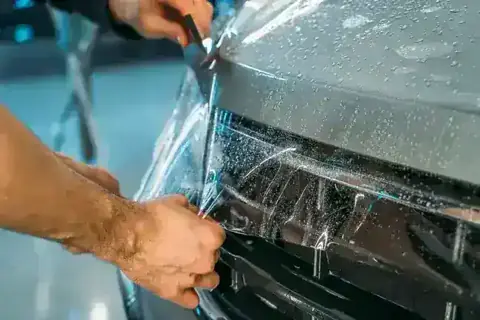
Owners planning another 3-5 years on the old car and caring about appearance should consider PPF paint protection film at least on the front group (hood, bumper, front fenders). PPF is the only physical barrier against stone chips and gravel, and on an old car that matters more: one deep chip on thin clearcoat is a panel-repaint job, and PPF stops it.

Polish or repaint — how to choose

The dilemma for a 10-15-year-old car is polishing versus local panel repaint. The answer depends on condition.

Polishing fits when: clearcoat is intact, no corrosion, gauge shows 75+ microns across panels, the main issues are swirl web and surface haze, budget is limited, the car is for personal use with no imminent sale.

Local panel repaint is more logical when: corrosion pockets are present, clearcoat on edges is worn to primer, the gauge shows critical numbers on several panels, the car is being prepared for sale with meaningful resale premium in mind, or there are one or two panels with deep damage while the rest is fine. Dealer repaint is typically much more expensive than studio polishing — it's multi-layer work with a booth, body technician, and painter. But on a single problem panel it is the only path.

Often the sweet spot is a combination: full-body polish plus local repaint of one or two problem panels. With a gauge on inspection, that is the plan the technician puts together.

FAQ

Does it make sense to polish a 15-year-old car?

Depends on condition, not age. 15-year-old with even clearcoat, no corrosion, 85-95 microns — polishes like any well-preserved car. 15-year-old with rust, worn clearcoat edges, 60-70 microns — risky, local repaint or walking away. The gauge decides.

What if the gauge reads 70 microns across the body?

The lower boundary for safe polishing. A two-step abrasive removes another 3-5 microns, leaving 65-67 — a critical minimum. The technician usually offers only a finishing compound with no cutting, or ceramic directly over current clearcoat.

If the car was polished 3 times, is another possible?

Most likely no. Three consecutive polishes remove 15-25 microns — from factory 100-120 that lands at 75-95, a fourth pass is in the risk zone. Gauge reading is mandatory. At 85+ a single finishing polish is possible. Below that — protection only.

Will polishing remove rust?

No. Rust is chemical destruction under the clearcoat; polishing works on clearcoat from the top. Polishing over rust is risky — abrasive thins the protection and rust spreads faster. Rust spots need local opening, converter, primer, paint — then polishing of adjacent zones.

Should ceramic go on an old car without polishing?

Can, but result is intermediate. Ceramic sits on any clearcoat but doesn't hide scratches. If budget is tight — a minimal finishing polish first, then ceramic on top. Not a full cycle but workable for an old car with limited clearcoat budget.

Conclusion

Polishing an old car is not a question of age but of condition. A garaged 12-year-old with original clearcoat and a 90-micron gauge reading polishes like a three-year-old and delivers the same effect. A street-parked 8-year-old with corrosion on arches and worn clearcoat edges is a candidate for local repaint, not polishing. The gap between these cases is 15 minutes of inspection and a gauge reading.

Three key limits: corrosion rules polishing out, worn clearcoat on edges requires local repaint, and a history of repeated polishing sharply narrows the window. If none of these apply, an old car polishes excellently and looks like new in 70-85% of cases.

Key takeaways:

  • Age of the car isn't the issue — condition of the clearcoat and remaining thickness on the gauge are
  • Safe polishing needs at least 75-80 microns of clearcoat left on a panel
  • Corrosion, worn clearcoat edges, and a history of repeated polishing are stop signals
  • Realistic result on a 10-year-old car is 70-85% of new condition
  • Ceramic on top or PPF on the front group holds the polishing effect longer

In-person inspection with a gauge and an assessment of car polishing feasibility — free before the procedure. Book with whichever BESTAUTO studio is more convenient in Tbilisi, Georgia:

  • BESTAUTO Guramishvili — Guramishvili Ave. 78, tel. +995 550 000 299
  • BESTAUTO Politkovskaya — Anna Politkovskaya St. 51, tel. +995 550 000 199

Both studios are open Monday to Saturday, 10:00–20:00. The technician measures clearcoat at 20-30 points across the body, shows the thickness map, and with that data you decide: polish now, defer, or stop at finishing work without abrasive.

Google Reviews
4.8 ★★★★★ (194)
View all reviews on Google
Why Choose Our Detailing Center?
You'll love the result
  • 5 Years of Detailing Experience
    Professional wrapping of hundreds of cars of different makes and models
  • 2 Studios in Tbilisi
    Guramishvili 78 and Anna Politkovskaya 51 — choose a convenient location
  • 2,000 Satisfied Clients
    Hundreds of reviews, 4.9★ rating on Google
  • 10-Year Film Warranty
    We cover peeling, yellowing, and material defects

Order professional polishing

Our detailing studio will handle your task with quality

Book a consultation

Choose the nearest studio
for a free consultation

Free inspection, pre-consultation and booking for main services available at both locations

BESTAUTO Guramishvili
Tbilisi, Guramishvili Ave. 78
BESTAUTO Guramishvili

Tbilisi, Guramishvili Ave. 78

+995 550 000 299
Mon–Sat 10:00 – 20:00
Enter phone in international format: +995 5XX XXX XXX
Request sent!
We will call you back within 15 minutes.
Or call us: +995 550 000 299
BESTAUTO Saburtalo
Tbilisi, Anna Politkovskaya St. 51
BESTAUTO Saburtalo

Tbilisi, Anna Politkovskaya St. 51

+995 550 000 199
Mon–Sat 10:00 – 20:00
Enter phone in international format: +995 5XX XXX XXX
Request sent!
We will call you back within 15 minutes.
Or call us: +995 550 000 199
Chat on WhatsApp
Choose your studio
Guramishvili Studio
78 Guramishvili St
Saburtalo Studio
51 Anna Politkovskaya St
Book a Free Inspection