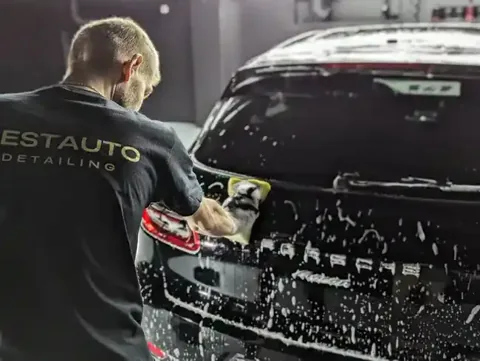
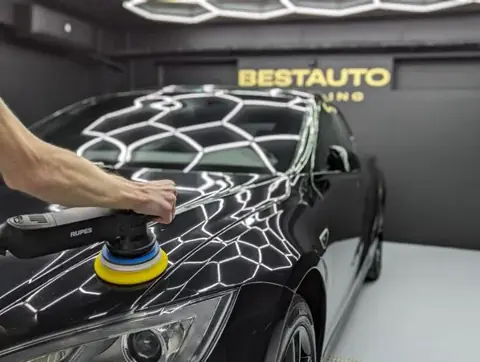
Highly recommend! Professional staff, flawless detailing, and my car has never looked better
Interior dry cleaning is several hours of professional studio work, hundreds of litres of chemistry, extraction, steam, ozone. The result — materials restored close to factory condition. What comes next is the most underestimated part of the story: the first 48 hours that decide whether the result holds 12-18 months or collapses in four weeks. In Tbilisi, Georgia with its summer heat and winter damp, this phase is particularly vulnerable. Below — five typical mistakes owners make after collecting the car from the studio, and how to avoid them without much effort.
Mistake 1. Sitting in the car within 24 hours of cleaning
The most common mistake is picking up the car and immediately driving to errands. The upholstery looks dry from the outside, but moisture inside the foam still sits there for 12-24 hours. Sitting on a seat before that moisture is gone presses body weight into the foam, fibres bond together while compressed, and when the foam later dries it keeps an uneven shape. Result — creases and "sagged" zones on the seat that weren't there before cleaning.
On leather the situation is worse. Lanolin-based conditioner absorbs over 4-8 hours; sitting down early transfers part of the product onto clothing rather than into the material. Three to four weeks later, that leather starts drying faster than protected areas, and micro-cracks appear.
Correct — leave the car at least 24 hours in a heated bay (this is what the studio does when handing over the next day) or in a cool garage. If you collected in the evening and still need to drive in the morning — don't carry heavy bags or shift weight around the cabin for the first day.
Exception — a short drive home from the studio parking lot. Acceptable if at least one night of rest sits between pickup and first full use.
Mistake 2. Eating and drinking in the cabin in the first 48 hours
Second by frequency — putting shopping on a seat right after cleaning, a coffee cup in the holder, unwrapping a snack in your hand. In the first 48 hours the protective layer on materials (especially fabric) is not fully set yet. Any liquid drop in this period soaks in deeper than after stabilisation and often becomes a visible stain — exactly what the cleaning was meant to prevent.
On leather it is equally critical: water or coffee spilled on freshly treated leather passes through the lanolin layer and soaks into the pores. Removing that later is harder than a normal stain — because part of it sits under the protective layer, and to reach it the layer has to be partially broken.
Correct — no food, no drinks, no open-package grocery transport for two days. That includes cars where "we always eat on the road": 48 hours of patience pays off via a full year or more of working protection.
Small but important — in the first 48 hours don't use clip-on air fresheners that stick to vent grilles. The formulation on those clips often contains alcohol that destroys the fresh plastic treatment around the vent.
Mistake 3. AC on max on day one
The third mistake — in summer heat, sitting in and immediately cranking AC to full. Logic is clear — cool the cabin as fast as possible. But after cleaning the upholstery still holds some moisture deep in the foam. A sharp cold dry air stream at top fan speed creates forced drying, but unevenly — the top layer of fabric dries faster than the foam underneath.
The result: surface warm outside, damp and cold inside. Condensation starts forming under the upholstery, in places you can't reach — between seat and backrest, under front mats. One to two weeks later this shows as a localised damp smell that neither airing nor an air freshener fixes.
Correct settings for the first 48 hours — AC at medium fan, moderate temperature (no colder than 22-23°C), airflow at the windshield and upward, not at the upholstery. This dries the cabin evenly, with no temperature gap between material layers.
Winter is the mirror case — don't put the heater on max with flow at upholstery. Same principle: a sharp temperature gap between surface and material depth is always bad for a freshly cleaned cabin.
Mistake 4. Parking in direct sun for the first week
The fourth mistake — open-sun parking in summer. Tbilisi June-August is 35-40°C air and up to 55-60°C inside a closed car. On dry material it is just hot; on freshly treated material after cleaning, it is destruction of the protective layer before it finishes curing.
Leather is especially exposed. Lanolin applied to it cures over 5-7 days; UV in the first days breaks that process. Instead of an even protective layer, an uneven coating forms with "burned" zones where the sun falls directly (dashboard, upper door cards, rear parcel shelf). Two to three months later these zones start differing in colour and feeling drier than the rest of the cabin.
Fabric and plastic also suffer, but less. On fabric UV combined with residual moisture in the pile can produce light fading — not a catastrophe, but a visible effect on dark tones.
Correct — first 7 days after cleaning, park in the shade, under a carport or in a garage. If no choice — use a sun shade on the windshield and, if available, on rear side windows. That drops internal temperature by 10-15°C and gives the protective layer a calm window to cure.
Mistake 5. Using an air freshener to "lock in the freshness"
The fifth, trickiest mistake — buying a strong air freshener and putting it in the car, because "it smells nice after cleaning, I want to keep that". Logic is clear, the effect is opposite.
A good dry clean removes odour causes — grease, sweat, microflora from fibre depth. In a properly cleaned cabin the natural neutral smell of the materials (faint leather aroma, light trace of fresh upholstery) comes through on its own, without additives. An air freshener over that does not add freshness; it overrides neutrality — and a week later, when the freshener's own smell vents out, the feeling is "something was there, now it's different". Many read this as "the smell is coming back", when in fact what's coming back is a normal state.
A more serious factor — the chemistry of air fresheners. Most budget clips and pendants contain alcohol, phthalates and silicones — substances that, in direct contact with a treated surface, destroy the protective layer. A freshener hanging on the mirror and dripping onto dashboard or shifter makes those areas develop a sticky sheen in a month; plastic loses its matte finish. That is not fixed by wiping — only by local re-treatment.
Correct approach — no air fresheners at all for the first 2-3 weeks after cleaning. The cabin naturally smells clean, which is the effect you want. After a month, if you must — choose quality options (a ceramic flacon with essential oil sitting on the dashboard) without direct contact with treated surfaces.
Short checklist: what to do right for the first 7 days
For those who want it short:
- 0-24 hours: don't sit in the car, don't put items on seats, leave the car in a cool garage
- 24-48 hours: short drives okay, no food or drinks in the cabin, moderate AC settings
- 48-168 hours (days 2-7): normal use but no spill-prone food, shade parking, no air fresheners
- After day 7: normal mode, air fresheners okay (no direct surface contact)
This minimum turns 500 ₾ for a medium-category clean into a year-long result instead of a one-month one.
What to do if you've already slipped
Some mistakes are reversible, some aren't. Short guide:
Spilled something in the first 48 hours. Blot immediately with a dry cloth (don't rub — that smears and pushes the stain into the fibre). Then call the studio — the first-week warranty often covers free local correction. Don't try to lift the stain with household chemistry — almost guaranteed to make it worse.
Ran AC on max and now there's a damp smell. Air the cabin — all doors open for a couple of hours on a dry day. Run the heater on medium for 20-30 minutes. If the smell stays — back to the studio; ozone at 50 ₾ usually resolves it.
Parked in the sun. If within a week — local plastic matte restoration at the studio (localised procedure at price-list rate). If 2-3 weeks later plastic already looks glossy — full plastic retreatment at the next scheduled visit.
Used a direct-contact air freshener. Remove, wipe the contact zone with dry microfibre. If a sticky sheen appeared — don't rinse with water (makes it worse), take the car to the studio for local re-treatment.
Sat in the car right away. Usually fine, but if upholstery "lies" unevenly — at the next clean, request extra "pile evening" treatment. Typically 1-2 extractor passes restore structure.
In any of these cases: a small mistake in the first days is not a catastrophe. The catastrophe is 2-3 mistakes combined. With one slip, it can almost always be fixed.
FAQ
How long after dry cleaning can I use the car normally?
Full unrestricted use — after 7 days. First 24 hours — don't sit in at all; first 48 — short drives only; days 2-7 — no food or air fresheners, but broadly close to normal. After day 7 the protective layer is fully stabilised and the car operates as usual.
Can I drive kids right after cleaning?
Yes, if the trip is short and no feeding in the cabin. First 48 hours — no kids with food, open juice and biscuits. Spilled juice in a freshly treated cabin becomes a stain, and that is a standard reason for studio returns. After 48 hours — normal mode with normal rules (no crumbs allowed, water bottle in the cup holder, food offered at home or in a cafe).
What if I spill water by accident on day one?
Blot with a dry cloth — don't rub, press and lift. Open windows for 30-40 minutes to speed evaporation. If no stain is visible after drying — nothing further needed. If one remains — call the studio, first-week warranty usually covers local correction free.
Why can't I use air freshener after dry cleaning?
The first 2-3 weeks an air freshener overrides the cabin's own neutral smell — and when it vents out, many owners read the shift as "smell coming back". Plus budget freshener chemistry contains alcohol and silicones that break the fresh protective layer in direct contact. After 3-4 weeks an air freshener is fine, just without direct surface contact.
What if I took a road trip right after cleaning?
If the trip was short (up to 2 hours/day) and without spills — usually no consequences, the protective layer stabilises in process. If it was a long trip with overnights and food in the cabin — bring the car in for inspection. Often local correction is enough; occasionally a repeat procedure under warranty if liquids were spilled.
Conclusion
Interior dry cleaning is an investment in eighteen months of use, not a one-off service. The first 48 hours after pickup decide whether that investment pays back in full or in part. Five typical mistakes — sitting too early, food in first days, AC on max, parking in sun, direct-contact air fresheners — are not theory but the most common reasons clients come back a month later asking "why already?".
Right use in the first week is not complex: don't eat in the car for two days, park in shade for a week, don't fit a freshener to the dashboard. That's not a "change your lifestyle" effort — it is literally five items, feasible without strain. In return — a full year-plus result instead of a monthly effect and repeat spending.
Key takeaways:
- First 24 hours — don't sit in the car; first 48 hours — no food or drinks in the cabin
- AC and heater on moderate settings for the first two days to avoid temperature gap between material layers
- Sun parking in the first week breaks down lanolin on leather and drives protection off plastic
- Air fresheners in the first 2-3 weeks are unnecessary — the cabin smells of its own cleanliness
- Any mistake in the first seven days — call the studio; local correction is usually free under warranty
Book interior cleaning at BESTAUTO via the form on the service page or call whichever studio is convenient:
- BESTAUTO Guramishvili — Guramishvili Ave. 78, tel. +995 550 000 299
- BESTAUTO Politkovskaya — Anna Politkovskaya St. 51, tel. +995 550 000 199
Both studios are open Monday to Saturday, 10:00-20:00. After dry cleaning — a detailed first-7-days care memo, so the result holds a year and more.