It's an ideal environment and situation!
Cloudy headlights are one of those problems an owner spots last. First the street feels darker, then oncoming cars seem to blind more than usual, and only at the car wash under a direct lamp does it show: the plastic lens has lost transparency, yellowed at the edges, picked up a fine web of scratches. In Tbilisi, Georgia this happens faster than in Europe — mountain sun with a high UV load, dust from alpine roads and sharp winter-to-summer swings eat through the protective lacquer on polycarbonate in 4-6 years. Transparency can be restored in two different ways, steam and abrasive. Below — when each works, and why the "headlight polishing from 150 ₾" line on BESTAUTO's price list covers two technologies for two jobs.
What modern headlights are made of and why they go cloudy
The outer shell of a modern headlight is polycarbonate — a tough transparent plastic. A factory 10-30 micron layer of protective lacquer sits on top and absorbs UV, dust abrasion and road chemistry. The polycarbonate itself stays clean and transparent underneath, as long as the lacquer holds.
Over time the lacquer degrades. UV breaks polymer chains; the coating hazes, yellows, then flakes off in microscopic chips. UV then reaches the polycarbonate directly and oxidises it — that is the "frosted glass" effect, the lens turning into a matt bathroom window.
The second source of cloudiness: micro-scratches from dust and sand. On Tbilisi roads particles hit at 80-100 km/h and act as a natural abrasive. A 5-7 year car carries thousands per lens, and light passing through scatters instead of forming a proper beam.
Restoration splits into two tasks: remove degraded lacquer with oxidised polycarbonate, and return optical smoothness. Steam and abrasive reach that along different paths.
Steam headlight treatment: how it works and what it delivers
Steam polishing heats the polycarbonate to the softening point of its top micrometre with vapour from a specific solvent (usually dichloromethane). The softened plastic fills micro-scratches the way melting wax fills a groove, and cools back as smooth.
Non-abrasive — no material is removed. Lens wall thickness stays the same, no risk of overheating LEDs or halogens inside. The job takes 20-40 minutes per pair. Lens is pre-washed, degreased, masked at the perimeter, and then vapour is introduced into a sealed chamber.
Steam handles surface haze and fine scratches without deep yellowing. The lens looks new — transparency across the whole plane, sharp beam pattern. A UV-protective spray lacquer or thin film on top extends the effect.
What steam cannot do: if the factory lacquer has flaked off and an oxidised yellow layer of polycarbonate sits underneath, steam will not remove it. The solvent softens the top, but the yellow pigment lives 50-100 microns deep. That is abrasive territory.
Abrasive headlight polishing: when nothing else works
Abrasive technology removes the top polycarbonate layer with everything oxidised and yellowed. Same principle as body polishing, except the material is plastic not clearcoat. Sequence — descending-grit sanding: 800, 1500, 2500, then 3-micron cutting compound, finishing with 0.5-micron paste for transparency.
30-80 microns come off, depending on yellowing depth. The lens is matt after sanding — normal; transparency returns with the finishing pass. 1-2 hours per pair, because each abrasive step needs an even pass: an extra 20 microns in one spot and the lens is thinner there, which later deforms under bulb heat.
After abrasive the lens is near-factory, no yellowing, full transparency. But without a topcoat this lasts 6-12 months: unprotected polycarbonate degrades faster under UV than laquered. Every abrasive job ends with a UV topcoat — aerosol or thin transparent film. Otherwise the cycle repeats in a year to eighteen months.
At BESTAUTO abrasive is the default for advanced cases. Pricing stays "headlight polishing from 150 ₾"; for heavily yellowed lenses requiring multi-stage abrasive plus a protective lacquer coat, the final figure is agreed at in-person inspection based on polycarbonate degradation.
How to tell which method fits your lenses
Five minutes under an ordinary daylight lamp is enough to distinguish two states.
Steam is enough if:
- the lens is evenly hazed but without a clear yellow tint
- the surface is smooth to the touch, no "flaking" feel
- the problem appeared relatively recently (last six to twelve months)
- the car is 3-5 years old, not subjected to extreme conditions
Abrasive is mandatory if:
- plastic is yellowed, stronger at the edges or in the centre
- the surface is rough to the touch, fingernail catches on lacquer flakes
- deep scratches from stones or car washes are visible
- the car is 7+ years old, headlights have never been serviced
- a previous DIY attempt with a shop-bought polish left streaks
Borderline case — medium degradation, where steam will deliver 70% of the result and abrasive 95%. Here the owner decides: if the car is up for sale in a month, steam does enough visually. If it stays in the family, abrasive plus a topcoat lasts 2-3 times longer.
How long the result holds and what to do next
Steam without a topcoat keeps transparency roughly 6-10 months in Tbilisi. With UV lacquer on top — up to 18 months. Abrasive plus lacquer — 18-30 months; with a transparent protection film — up to 5 years.
The gap is simple: steam works with a surface layer that keeps degrading under UV anyway. Abrasive removes damaged material down to healthy plastic, so degradation restarts from zero. A lacquer or film on top slows the process 3-5x because UV is absorbed by the sacrificial layer, not the polycarbonate.
What accelerates the return of cloudiness:
- storing the car outdoors through summer (mountain UV in Tbilisi)
- brush-type automatic washes — stiff nylon fibres leave micro-scratches
- aggressive degreasers and de-icers with high pH
- parking nose-to-south, where lenses bake under direct sun every day
What extends the effect: hand washing every 2-3 weeks, a protective film on the headlights (from 350 ₾ in the price list), parking nose-to-wall or under a carport.
Headlight polishing alongside the rest of the car's protection
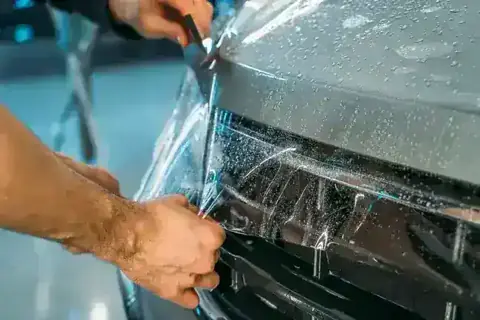
Headlights are part of the front group and catch the same things as the hood — stones, tar, sand from mountain roads. Polishing restores transparency but does not protect polycarbonate from fresh chips. For physical protection — PPF paint protection film over the lens, which takes the hit and lasts 5-10 years. A typical front-group package covers headlights along with hood and bumper, since all three zones see the same loads.
At BESTAUTO package deals break down into components: headlight polishing from 150 ₾ plus headlight protection film from 350 ₾. Final figure is set at inspection — depends on lens size, geometry and wear.
The full pricing block for every type of car polishing is on the service page. The headlight quote is individual: SUV lenses are larger, a mid-size European sedan falls under the standard rate.
FAQ
Can I do steam headlight polishing at home?
Technically you need a sealed chamber, clean dichloromethane, protective gear (vapour is toxic), surgical cleanliness and timed exposure. Any mistake — streaks on the plastic, only abrasive fixes it. For most owners it is not saving money but risk; studio headlight polishing from 150 ₾ costs less than one new lens after a failed DIY.
How long until I can wash the car after headlight polishing?
After steam — 24 hours for the fresh lacquer to reach initial hardness. After abrasive with finishing lacquer — 48 hours. First two days avoid chemical car washes and high pressure; a light hand rinse without shampoo is fine. After a week the usual routine is back.
Does headlight polishing help weak halogen light?
Yes, if haze was the cause. Oxidised polycarbonate scatters up to 40-50% of the output — after polishing the car throws near-factory beams. If the light was weak from the start (old bulbs, yellowish spectrum), polishing the housing will not fix it — new bulbs, or in edge cases a projector retrofit.
How much does headlight polishing cost in Tbilisi?
At BESTAUTO — from 150 ₾ for headlight polishing (steam on light cases). For heavily yellowed lenses needing multi-stage abrasive plus protective lacquer the final figure is agreed at inspection. The full pricing block for every type of car polishing is on the service page. The specific figure is quoted at in-person inspection after grading degradation.
The headlights yellowed again six months after polishing — what went wrong?
Usually a missing topcoat. Raw abrasive without UV lacquer lasts 6-12 months in Tbilisi — a normal span, just a short one. After steam even shorter. Fix: after any headlight polishing, always a protective lacquer or film, otherwise the cycle repeats annually.
Conclusion
Steam treatment and abrasive headlight polishing solve the same task — return of transparency — but address different damage levels. Steam — for surface haze and light cloudiness, half an hour of work, holds for 6-10 months. Abrasive — for yellowing and deep degradation, 90 minutes of work, with a topcoat lasts up to 30 months.
Method selection happens at inspection: the technician looks at the surface under directional light and decides whether a yellow layer is embedded in the plastic or there is only a surface haze. For most 5-7 year cars steam with a UV topcoat is enough; for 8+ year cars with no prior service history, only abrasive makes sense.
Key takeaways:
- Steam headlight polishing is non-abrasive, lasts 6-10 months, from 150 ₾
- Abrasive polishing removes 30-80 microns of polycarbonate, with protection up to 30 months
- Without a topcoat or film on top, any method delivers only a short-lived effect
- The line between methods runs along presence of a yellow layer embedded in plastic
- Protective PPF film over the lens extends polishing result up to 5 years
Book headlight polishing at BESTAUTO via the form on the service page, or call whichever studio is more convenient in Tbilisi, Georgia:
- BESTAUTO Guramishvili — Guramishvili Ave. 78, tel. +995 550 000 299
- BESTAUTO Politkovskaya — Anna Politkovskaya St. 51, tel. +995 550 000 199
Both studios are open Monday to Saturday, 10:00–20:00. A free in-person inspection comes first — the technician grades the level of degradation and picks the method, steam or abrasive, for the specific case.