When choosing a wash in Tbilisi many owners see two items on the price list — "2-phase" and "3-phase" — and cannot tell what separates them beyond the 15 lari gap. Short answer: a 2-phase wash removes dirt and restores a clean look; a 3-phase wash adds a protective layer that lasts 3-4 weeks. Long answer below — step composition, chemistry, effect duration, and a clear rule for when paying for the third phase makes sense and when it does not.
A 2-phase car wash is the classic base cycle of a professional detailing-studio wash. The name reflects the two functional stages: chemical pre-wash and hand wash with rinsing. No protective compounds at this tier — the job is only cleaning the body.
Step by step:
Phase 1 — pre-wash with active foam. A foam cannon lays a coat of foam over the body. Chemistry works for 3-5 minutes — during that time foam lifts the bulk of contamination off the clearcoat: dust, insects, rain spots. Rinsed at 100-120 bar together with the softened dirt. Nobody touches the body at this stage.
Phase 2 — hand wash using the two-bucket method. One bucket with pH-neutral shampoo, the other with clean water and a grit guard on the bottom. A microfibre Plush mitt goes into the soapy bucket, runs over one panel, rinses in the clean-water bucket (grit stays behind), back into the soapy one. Panel by panel. Then rinse at pressure, dry with microfibre or a blower in an enclosed bay.
After those two phases the car is clean — no dust, no spots, no water streaks. But the body is "bare" afterwards — no protective layer on top. If nothing is added, dust starts settling on the paint within 2-3 days, and the first rain will leave flat water sheets instead of beaded droplets rolling off.
In the BESTAUTO price list a 2-phase wash is 40 ₾ for a sedan and 45 ₾ for an SUV. The 5-lari gap is purely vehicle size and extra chemistry and time.
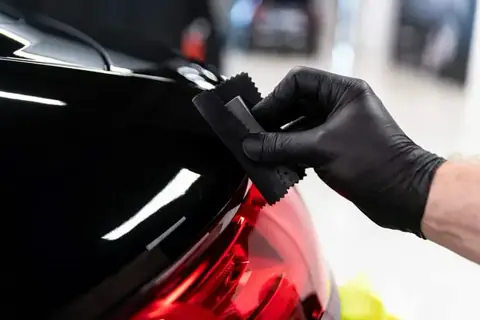
A 3-phase wash is the same two phases (pre-wash + hand wash) plus a third stage: a protective compound applied after rinsing but before drying. The third layer gives the car a temporary hydrophobic effect and a light wax-style coating that lasts 3-4 weeks.
What the third phase physically is:
Results you see even a week later:
In the BESTAUTO price list a 3-phase wash is 55 ₾ for a sedan and 59 ₾ for an SUV. The 15-lari gap to 2-phase covers the protective compound plus an extra 10-15 minutes of technician time.
The key thing about the third phase: it is not a ceramic-coating replacement and not a PPF equivalent. It is a temporary protective layer with a limited lifespan, working in two modes.
Hydrophobic effect — 3-4 weeks in city use. For the first two weeks water on the body behaves like on freshly applied ceramic — beaded droplets, self-shedding, minimum streaks. By week three the effect starts to weaken, by the end of week four it is nearly gone. Heavy rain or an intervening wash during that window shortens the effect.
Anti-adhesion — 2-3 weeks. Dust and light dirt stick worse to the surface. The next wash is easier — less chemistry and effort. For weekly washers, a real saving on chemistry.
Optical depth — right after the wash, fades in a week and a half. The clearcoat looks deeper and richer than after 2-phase. Especially visible on dark colours — black, dark blue, dark green. Highlights are sharper in week one, the colour looks "denser". By the end of week two the effect levels back to normal.
What the third phase does not deliver:
The third phase does not always earn its 15 lari. Four scenarios where it delivers, and several where it just burns money.
Take 3-phase if:
Skip 3-phase if:
Simple rule: if you have ceramic or PPF — take 2-phase, the protection is already on the car. If not — 3-phase once a month adds a light extra layer between scheduled procedures.
On a ceramic coating the wash job is different: not to create new protection but to preserve existing protection. That calls for a 2-phase wash with pH-neutral shampoo, no third phase. Ceramic lasts 2-5 years and its hydrophobic effect is a chemical SiO2 bond with the clearcoat, not a wax film on top. An added wax booster on ceramic either rolls off immediately or creates an intermediate layer that washes off in two weeks, leaving ceramic as normal.
Similar logic for PPF. Polyurethane film is sensitive to solvent chemistry — a third phase with a wax booster is usually safe, but a SiO2 nano-shampoo on fresh PPF (first 2-3 weeks after installation) can leave streaks that are hard to remove later. On film older than a month — acceptable, but little point: the film is inherently hydrophobic.
On a PPF-coated car the wash must be strictly pH-neutral and solvent-free — that matters more than the 2 vs 3 phase choice. More on chemistry requirements in the article on PPF paint protection film and why neutral washing is non-negotiable.
The gap between 2-phase and 3-phase is fixed in the price list: +15 ₾ for sedans (40 ₾ vs 55 ₾), +символически for SUVs (45 ₾ vs 59 ₾). That covers the protective compound and 10-15 extra minutes of technician time — identical regardless of season or car condition.
On yearly spending the decision reduces to a simple choice: take the third phase every time, every other time, or almost never.
Full pricing lives on the detailing car wash service page, and the final figure is set on inspection — vehicle size, condition, and presence of coatings all factor in.
Engine bay wash is a separate line item at 80 ₾. It is not part of either 2-phase or 3-phase body washes and is done as needed, usually every 6-12 months.
2-phase is cleaning: pre-wash with active foam plus hand wash using the two-bucket method. 3-phase adds a protective layer as a third step after rinsing. The third phase gives 3-4 weeks of hydrophobic behaviour and boosts the paint visual. Price gap — 15 ₾ for a sedan (40 vs 55 ₾), символически for an SUV.
No, that option does not exist. If the third phase is not needed, book 2-phase at 40/45 ₾ directly. "3-phase minus the third phase" = 2-phase, logically and by price. That is why the menu has two separate items, not one with optional add-ons.
No. Ceramic already delivers the hydrophobic effect for 2-5 years, and a third phase adds nothing — either rolls off or sits on top for 2-3 weeks without visible benefit. On a ceramic-coated body always take 2-phase.
The difference is in the nature of the layer and its lifespan. Third phase is a thin wax or polymer film on the clearcoat surface — duration 3-4 weeks. Ceramic is a SiO2 layer chemically bonded to the clearcoat up to 5-10 microns thick — duration 2-5 years. Ceramic costs from 500 ₾ once, 3-phase wash is +15 ₾ every time. Different products, different use cases.
In the first 7-10 days after installation washing is not recommended at all — the adhesive needs to cure. After that — strictly 2-phase with pH-neutral shampoo, no solvents, no stiff brushes. 3-phase on PPF is acceptable after one month but delivers little: the film is hydrophobic by itself.
2-phase and 3-phase washes are two tiers of the same base service, not two different products. 2-phase cleans the car (40 ₾ sedan / 45 ₾ SUV), 3-phase adds a protective layer for 3-4 weeks (55 ₾ sedan / 59 ₾ SUV). For an unprotected body 3-phase delivers visible value — hydrophobic behaviour, easier following washes, visual paint depth. For a ceramic- or PPF-coated body the third phase is redundant — protection is already there and working on its own timeline.
The optimum for most Tbilisi owners is a mixed strategy: regular week 2-phase, before rainy weather or a trip 3-phase. This approach keeps the paint in good shape without a material hit to the budget and lets the third phase come in exactly when it actually earns its place.
Key takeaways:
Book a car wash at BESTAUTO via the form on the service page, or call whichever studio is closer in Tbilisi, Georgia:
Both studios are open Monday to Saturday, 10:00–20:00. On inspection the technician identifies which phase fits the car's condition and the type of protective coating.
Then comes careful washing. Its purpose is to remove dirt without creating new defects. This is one of the key differences between standard washing and detailing logic: rough contact, poor towels, and aggressive brushes often damage the appearance instead of helping it.
Even after washing, invisible contamination often remains on the surface: tar, sap, iron particles, and embedded residue. These are removed with the right chemical and, when needed, mechanical decontamination. This stage matters because neither polishing nor protective coatings perform properly on an unprepared surface.
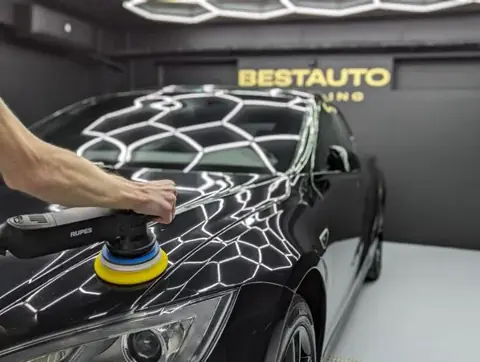
If the paint looks tired, hazy, scratched, or uneven, polishing becomes the stage that restores clarity and reflection. The intensity of correction depends on the actual condition of the lacquer. Sometimes a light enhancement is enough. In other cases, a more involved correction is justified.
Once the surface has been corrected, it is cleaned again so that any chosen protection can be applied to a properly prepared base. This is where long-term quality really begins.
Exterior detailing can include:
The exact set depends on the vehicle’s condition and on the owner’s goals.
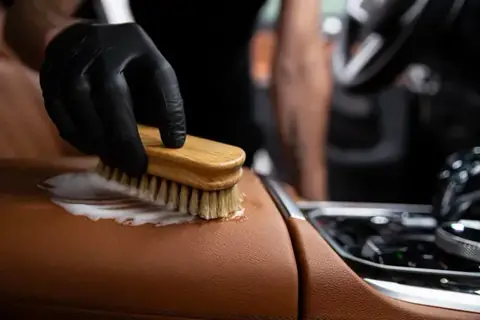
Interior detailing typically includes:
The goal is not just to make the cabin look clean at first glance, but to reset the environment more deeply and more correctly.
Wax is the simplest and shortest-term option. It can improve shine and water behavior, but it is not a serious long-term protection strategy.
Sealants usually last longer than wax and can provide a more stable maintenance benefit, but they still sit below ceramic coatings and PPF in terms of overall protection logic.
Ceramic coating is primarily about stronger gloss, easier washing, better hydrophobic behavior, and more stable daily appearance. It is very useful for maintenance and visual preservation, but it is not a true shield against chips and road impact.
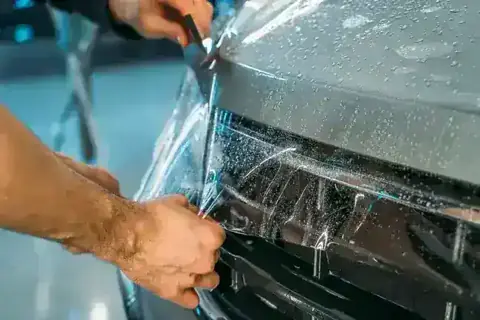
PPF is the most serious option when the goal is real physical protection. It helps protect the paint from chips, light abrasion, road debris, and daily mechanical stress. If the vehicle is new, valuable, heavily used, or the owner wants to preserve the original finish, PPF is usually the most rational solution.
Georgia creates a demanding environment for cars. Strong sun, dusty roads, mixed urban and highway use, mountain routes, seasonal contamination, and inconsistent wash quality all make professional care more relevant. A car that is left without proper care in these conditions will almost always age visually faster.
A good studio is not defined only by nice photos. You should look at the workspace, lighting, preparation standards, product transparency, real before/after examples, and how clearly the team explains what is actually needed for your car.
The result of detailing depends not only on the studio, but also on what happens afterward. Safe washing, the right chemicals, soft contact methods, and reasonable maintenance intervals all help the result last longer. Poor aftercare can quickly undo even very good work.
The cost always depends on the service itself, the vehicle’s size, its condition, and the final goal. A basic safe wash, interior deep cleaning, paint correction, ceramic coating, and PPF are not services of the same class, so the pricing logic is naturally different.
Basic care is absolutely possible at home, but once we are dealing with polishing, ceramic coating, or especially PPF, the results depend heavily on tools, lighting, prep, and experience.
There is no single universal schedule. It depends on use, storage, washing habits, and the level of protection already present on the car.
A high-quality clear PPF installation is usually visually unobtrusive, especially when edges and fitment are done properly.
Yes, when done correctly, PPF can be removed and replaced. That is one of its major long-term advantages.
Detailing is not just about making a car look attractive for a short time. It is a structured approach to keeping the vehicle cleaner, fresher, more comfortable, and better protected over time. Exterior care, interior care, and the right protection all work together.
If your goal is only a quick visual refresh, many simpler services can help. But if you want a truly well-kept car in Georgia’s real-world conditions, then proper detailing — and especially the right protection strategy — becomes one of the smartest investments you can make in the vehicle.
Our detailing studio will handle your task with quality
Book a consultationBook a visit
Write your phone number, we will call you back and tell you everything about the service you are interested in
Free inspection, pre-consultation and booking for main services available at both locations