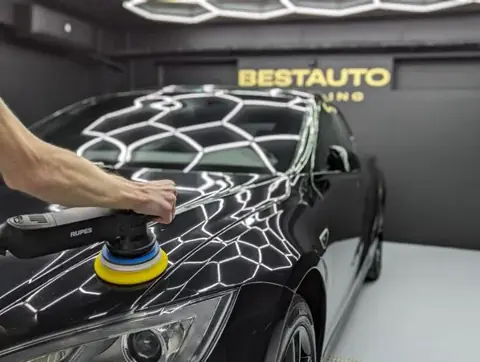
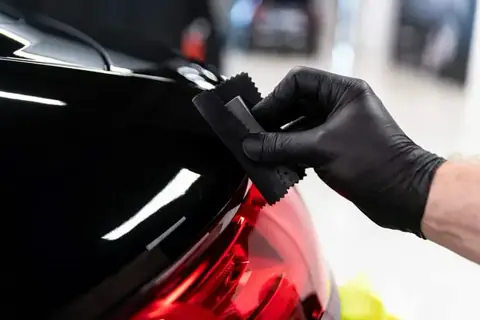
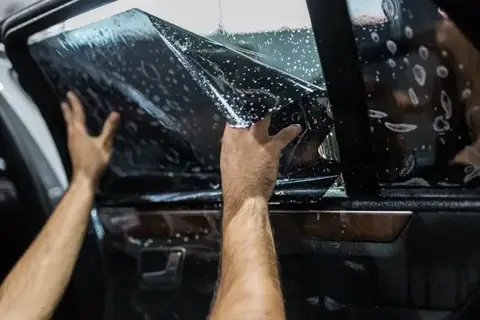
The guys did a fantastic polishing job, touched up the chips and removed all visible imperfections. As a bonus, they polished the headlights and also cleaned up the interior. The car looks like new.…
Of all the features of paint protection film, the self-healing trick looks the best on a showroom demo: the installer runs a key over the hood, pours hot water, and the mark disappears in 10-15 seconds. This is not a marketing stunt or an optical illusion. PPF self-healing really does work — but only on a specific type of damage and under strict physics. This article explains what self-healing is at the molecular level, which defects heal and which do not, and why premium films close scratches faster than budget alternatives.
The physics: an elastomer with thermal memory
Self-healing is not a property of polyurethane in general. It belongs to a single layer — the top elastomer coating, 10-15 microns thick. The 150-200 micron base polyurethane underneath has no thermal memory: its job is to absorb stone impacts and return to shape, but the material itself is hard and rigid.
The top layer is made from a specific urethane elastomer with a "block" molecular structure. Long polymer chains are tangled together like a ball of rubber threads. When a fingernail or a branch scrapes across the surface, those chains shift — a microscopic groove forms. But the chains remain connected and keep pulling each other back toward their original positions.
At room temperature (20 °C) those forces are weak: the polymer sits in a rigid, glass-like state and the micro-scratch stays visible. As soon as the top layer heats to 40-60 °C (which is normal on a sunlit panel in Tbilisi in summer), the polymer moves into an elastic state — molecular mobility increases sharply, and the chains pull the surface flat again in seconds. The groove "fills in" on its own.
The familiar analogy is a rubber toy: push a finger into it and a dent stays until the finger is lifted. Only here the "finger" is molecular tension, and the mark disappears with heat, not with release.
What actually heals and what stays forever
The distinction matters because clients often expect more from self-healing than it can deliver.
What heals: surface scratches up to 10-15 microns deep. That matches the thickness of the top elastomer layer. Concrete examples include marks from a soft car-wash brush, a branch scratch from parking under a tree, a scuff from a button on someone's sleeve who leaned on the car, a trace from a card or fob near the door.
What does not heal: cuts deeper than 15 microns (they reach into the base polyurethane), punctures from a nail or sharp tool, marks from sulfuric acid or aggressive solvent (chemical damage, not mechanical), swelling and clouding from long UV exposure on aged film, marks from thermal sources (cigarettes, hot exhaust).
Useful test: run your fingernail across the surface. If you feel a clear ridge, the damage is beyond self-healing. If the mark is visible only at a certain light angle and the surface feels smooth, that is exactly the kind of micro-scratch the film will close on its own.
On premium films BESTAUTO works with — Llumar, LuxArmor and Quantum — the healing depth limit is a little further out (15-20 microns) thanks to a thicker top layer. Budget Chinese films often have a 5-8 micron top layer, and there even shallow wash marks stay visible.
Heat as the trigger: sun, water, heat gun
Self-healing needs heat, but not extreme temperatures.
Direct summer sun in Tbilisi. A dark hood in July reaches 55-70 °C — comfortably above the activation threshold. Micro-scratches picked up after a morning wash usually disappear by evening without further action. Lighter panels stay cooler (40-50 °C), the effect is slower, but it still works.
Warm water at 50 °C. The main "instant" method. Tap water at a wash on the warm setting is usually 40-50 °C, which activates healing within 30-60 seconds of direct contact. That is why film looks fresh after a good hand wash: fine marks from the previous week closed during the process.
Hair dryer or heat gun. A fast way to treat a specific spot locally — 60-80 °C, 20-30 seconds at 15-20 cm distance. Used in the studio after a fresh scratch when the client does not want to wait for the next sunny day.
Tbilisi winter at +5 °C. No natural activation — surface temperature rarely climbs above 20 °C. Micro-scratches accumulate and wait for spring or a deliberate warm wash. That is normal: winter marks close with the first warm weeks of March.
Important: cold water does not trigger the effect. If the film never rises above room temperature, self-healing stays silent. So in winter or rain the effect looks "invisible" — that is expected behaviour, not a film defect.
Brand differences in healing speed
All premium films offer self-healing, but the speed varies by a factor of 2-3 depending on the top-layer formulation.
Llumar. Standard healing speed: 5-10 seconds on a 50 °C surface for a 5-micron scratch. A balanced top layer that works across the 30-70 °C range. Manufacturer warranty on self-healing: 10 years.
LuxArmor. Faster: 3-7 seconds at the same temperature. The top layer is a bit thicker than standard (up to 18-20 microns), extending the depth range of scratches it can close. Good fit for cars in active use where micro-scratches accumulate faster.
Quantum. Average 5-8 seconds, but with a lower activation threshold: the effect is visible as low as 30-35 °C. Useful in spring and autumn in Tbilisi when surface temperatures often sit at 30-40 °C without direct sun.
For a real owner, the difference between the three brands shows up in edge cases — winter with rare warm days, or a car without garage. In day-to-day summer use in Tbilisi all three have plenty of headroom.
Budget Chinese films advertise self-healing, but in practice their top layer is thinner and poorer in elastomers. The effect may need 55-60 °C and only works on very shallow scratches. After 2-3 years the self-healing on those films usually disappears entirely.
How self-healing ages and when it fades
A polymer elastomer is not an infinite material. Its molecular structure changes slowly under UV, thermal cycling, and chemical exposure.
For the first 3-5 years self-healing runs at 95-100% of the manufacturer's stated speed. Then effectiveness drops gradually: polymer chains lose some elasticity, some bonds break and do not reform. By years 7-8 on a premium film (Llumar/LuxArmor/Quantum), healing slows to 60-70% of original speed and starts requiring higher temperatures (55-65 °C instead of 40-50).
By year 10-12, beyond the warranty window, a quality film still usually retains some self-healing, but noticeably slower. This is one of the signals that it is time to think about replacement: the impact protection still works, but cosmetic marks no longer close themselves.
What accelerates aging: constant parking in direct sun (particularly on open lots in Tbilisi summer), regular washing with aggressive alkaline chemistry, repeated mechanical impact in one spot. What slows it down: garage storage, hand wash with pH-neutral products, periodic ceramic booster on top of the film.
Practical use: when to deliberately trigger healing
Most of the time the effect works on its own without owner involvement. But a few scenarios are worth activating it deliberately.
After a dusty drive. Wiping dust off a dry hood with a hand almost guarantees micro-scratches. After a warm-water wash they close. Better: don't wipe dry — head straight to a wash. If you must, spritz water from a bottle and lift dust with microfibre gently.
After a brush car wash. If for some reason you had to use a brush wash (say, on a trip in another city), leave the car in the sun for a couple of hours. Brush marks close without any polishing.
Before a resale viewing. A week before meeting a buyer — a good warm-water wash and daytime sun parking. The car shows up without a week of accumulated marks.
After winter, on the first warm days. Micro-scratches accumulated over cold months close with one or two warm hand washes in April or May. Polishing is typically not needed.
There is no need to do this every day — the film handles routine marks on its own. In the scenarios above, however, deliberately applying heat speeds up the result.
FAQ
Does self-healing work on any scratch?
Only surface-level, up to 10-15 microns deep (up to 15-20 on premium). That matches marks from wash brushes, branches, cards, fobs. Deep cuts, punctures, or marks from metal tools do not heal. If you feel a clear ridge with your fingernail, the film will not close that by itself.
How long does a scratch take to disappear?
On premium film (Llumar, LuxArmor, Quantum) at a 50 °C surface temperature — 5-10 seconds. In direct summer sun in Tbilisi — usually under a minute. In winter at +5 °C the effect is off; warm water or a heat gun is needed. A completely cold film does not close a scratch at all.
Can a heat gun speed up healing?
Yes, that is the standard studio method. A hot heat gun at 15-20 cm for 20-30 seconds and the scratch closes. Important: don't exceed 80 °C in one spot — that can damage the adhesive layer underneath. A household hair dryer also works, just more slowly.
Why does cheap film heal worse?
The top elastomer layer on budget film is thinner (5-8 microns versus 15-20 on premium) and poorer in quality polymers. Activation threshold is higher (55-60 °C instead of 40-50), and the depth range of closeable scratches is narrower. After 2-3 years the self-healing on those films usually fades entirely.
How can I check if my film still self-heals?
Simple test: run your fingernail (not a key) over an inconspicuous area. If a faint mark appears, warm the area with a heat gun or park in the sun for 30-60 seconds. If the mark disappears, the effect is alive. If it persists, the top layer is worn — time to consider replacement.
Conclusion
Self-healing is a real, physically grounded technology — not a marketing trick. It works on surface scratches up to 10-15 microns, activates from 40 °C upwards, and holds for 8-10 years on premium brands (Llumar, LuxArmor, Quantum) in Tbilisi conditions. This is one reason PPF pays back on premium cars over the long run: the paint underneath is not only protected from chips, it also does not need polishing to remove everyday marks.
Important to keep in mind: self-healing does not replace careful use. Deep cuts, punctures, and chemical damage stay forever. But the everyday micro-scratches that would otherwise mean a polish every 1-2 years on bare paint — those close by themselves under the sun on a film.
Key takeaways:
- Self-healing lives in the 10-15 micron top elastomer layer only
- Activates with heat from 40-50 °C: sun, warm water, heat gun
- Closes surface scratches in 5-30 seconds; deep cuts do not heal
- Premium films (Llumar, LuxArmor, Quantum) are faster and deeper than budget ones
- Effect weakens after 7-8 years and fades by 10-12, which is a replacement signal
Book paint protection film at BESTAUTO via the form on the service page, or call whichever studio is more convenient in Tbilisi, Georgia:
- BESTAUTO Guramishvili — Guramishvili Ave. 78, tel. +995 550 000 299
- BESTAUTO Politkovskaya — Anna Politkovskaya St. 51, tel. +995 550 000 199
Both studios are open Monday to Saturday, 10:00–20:00. A free in-person inspection comes first — the technician measures the car, evaluates paint condition, and proposes the optimal scope of film for your use case.