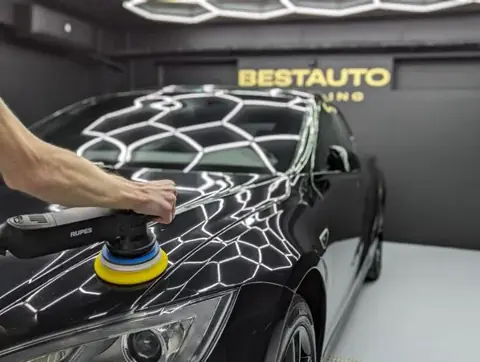
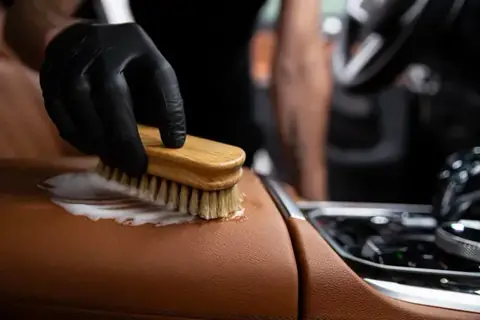
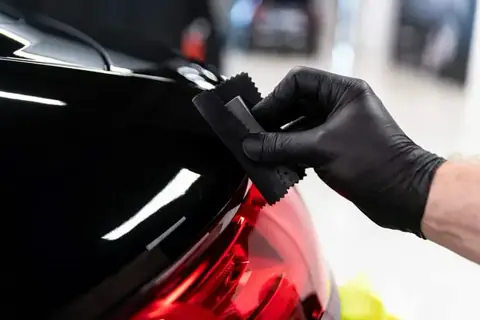
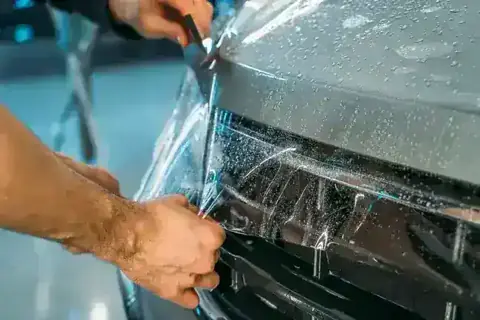
The guys did a fantastic polishing job, touched up the chips and removed all visible imperfections. As a bonus, they polished the headlights and also cleaned up the interior. The car looks like new.…
A Karcher and its analogs are convenient machines but dangerous in hands that have not read the manual. Modern consumer pressure washers easily reach 180-220 bar, and at that level any mistake — wrong angle, too close a distance, dwelling on one spot — leaves a mark on the paint or tears off what was applied on top (PPF, vinyl logos, trim moldings). Below are concrete safety limits, what can actually be damaged, and how to correctly wash your car with a pressure washer at home so that a weekend routine does not turn into a film repair bill starting at 2500 ₾.
Safe pressure: 100-150 bar, critical — above 200
Consumer washer brands love marketing "220 bar, twice the power", but for a car body that is not a plus — it is a risk. Most professional detailing studios use 100-120 bar — enough to rinse foam and dirt off, not enough to physically damage the coating. PPF manufacturers state it plainly in their guidelines: no more than 150 bar, and no closer than 30 cm from the film.
The difference shows in examples. At 120 bar the jet works as "strong rinse" — powerful but unable to physically damage the surface. At 180 bar the same jet can lift a butterfly off the grille, but at the same time lift a PPF edge if aimed at the seam. At 220 bar this is a tool for cleaning a concrete path, not a car.
If you own a 180-bar-plus washer, use it on minimum setting (the gun usually has a regulator or a diffusing nozzle). The flattest and widest jet — the 25° fan nozzle — is safer than the pinpoint 0° one. Do not use the pinpoint nozzle on a car body at all.
Distance to body — minimum 30 cm
The main home-wash mistake is getting close "to rinse better". At 5-10 cm from the body, a jet at 150+ bar works like a knife: tears paint at chip spots, lifts film edges, pops rubber out of door seals. At 30-40 cm the pressure spreads across a wider area, and the risk drops dramatically.
Practical spots where distance matters especially:
- PPF edges (film edges on the hood, bumper, arches) — minimum 30 cm, better 40
- Vinyl logos and decals — same 30-40 cm, a perpendicular angle will lift the decal over time
- Door, trunk and hood seals (the black rubber around the perimeter) — no closer than 25 cm
- Radiator grille — angle the jet, not perpendicular, and 30+ cm away
- Wheel arches and inner liners — closer is OK (20 cm), but plastic liners on some cars are brittle
A good benchmark — an arm's length from the gun to the body. If your arm does not reach, you are too close.
Jet angle: 45° optimal, 90° forbidden on edges
A perpendicular (90°) jet is the most destructive. All the energy hits one point, and if a film edge, a decal or a weakly-fixed molding happens to be there, it will be ripped off. Practical rule: on edges and "seams" of the body the angle should be 30-45°, not perpendicular.
Correct technique:
- Start washing from the top (roof) and move down — following the natural water flow
- Guide the jet along edges, not across — parallel to the edge of PPF or a decal
- Above seals and black plastic trim — 30-45° angle, not straight down into the seam
- On mirrors and antennas — steer the jet away, do not aim directly
On areas free of film or trim (middle of the hood, doors, trunk lid) — 45-60° is enough and safe.
What can break with wrong technique
To understand the risk boundary, here is what actually fails under wrong technique:
PPF film. Most frequent damage. A perpendicular jet at 10-15 cm from an edge lifts it in a second. Then the film keeps peeling by itself during daily use. Repair — replacement from 600 ₾ per panel if only one zone is affected, or a full hood from 800 ₾.
Vinyl decals and logos. Thinner than PPF and tear easier — even at 120 bar with a perpendicular jet. Replacement depends on the decal type.
Door and trunk seals. Old rubber seals (cars from 2010 or earlier) crack and slip out of their groove under high pressure. Water then enters the door opening during rain. Seal replacement is a separate budget, sometimes involving disassembly.
Inner wheel liners. On some cars they are brittle plastic that cracks under a direct jet at close range. New cars (2018+) mostly use tough polypropylene — not an issue — but 2010-era cars can crack.
Badges and emblems. Adhesive badges on the trunk and fenders come off at close range under a perpendicular jet. Then — glue them back or search for new ones.
Electronics in the engine bay. If you decided to work under the hood with the same washer — see the separate article on engine-bay wash. Short answer: do not. High pressure straight into electronic modules, connectors and the alternator risks shorts and failures.
Never-do list — red-flag items
Some techniques are dangerous enough that they should not be repeated even with the safest hardware:
- Perpendicular jet on a PPF or decal edge — always a peel risk
- Over 150 bar on any film surface — PPF manufacturers expressly forbid it
- Under 20 cm from the body — anywhere, regardless of angle
- Pinpoint nozzle (0°) on the body at all — concrete-and-tile tool only
- High-pressure jet into door gaps — water enters fabric upholstery and electrical connectors in doors
- Consumer pressure washer under the hood — a separate procedure done in a studio with low pressure and electronics protection
- Perpendicular jet into the exhaust pipe — if the engine is warm, water enters the system
Home wash — step by step
If you decide to wash at home with a pressure washer, the safe sequence is:
- Pre-rinse — remove the first layer of dust and loose dirt from maximum distance (50-60 cm), so the abrasive is not pushed closer later
- Foam application from a foam cannon or a hand sprayer, dwell 3-5 minutes
- Foam rinse — from 30 cm, at 45°, top to bottom, section by section (hood → roof → right side → left → front → rear)
- Wheel arches and rims — closer is fine (20 cm), but not perpendicular to the inner liners
- Final rinse — from a big distance (50 cm), a quick pass to remove residual foam
- Dry — microfibre or a blower; do not leave droplets on the body under sun
Total time — 15-20 minutes of careful work. Going faster raises the risk of aiming the jet where it should not go.
When not to try at home
There are cases where a home pressure wash creates more risk than it saves in time and money:
- The car has PPF or ceramic coating — one mistake, and repair costs more than an annual detailing-wash pass
- Dark-coloured car — after high-pressure mistakes, microcracks on the clearcoat show up immediately
- Winter with sub-zero temperatures — water freezes in locks, around seals, inside door gaps
- Before sale — at the showing even a small defect can drop the price by more than the wash cost
- A consumer washer at 180+ bar with no pressure regulator — virtually guaranteed problems on edges
If you fall in one of these categories, it is cheaper to drop the car off for a 2-phase studio wash at 40-45 ₾ than to try at home at risk. Current pricing — on the detailing car wash page.
Home wash vs studio for a PPF car
A car with a full PPF package (hood + bumper + front fenders + pillars — package from 2500 ₾) is a separate story. The film is sensitive not only to pressure but also to chemistry, water temperature and wash angles. Even if you do everything right, after a year or two of home washing you will see micro-damage on the edges that would not have appeared after a studio wash at 100-120 bar with pH-neutral chemistry.
Polishing can refresh the look but does not protect against new chips and does not restore a film that has already lifted. A more reliable solution for keeping protection intact is PPF paint protection film with proper care from installation to first replacement. Washing such a car at home saves half an hour and costs a re-install in the long run.
FAQ
What pressure is safe for a car?
100-150 bar is the safe range for most cars without PPF. For PPF cars the film maker states 150 bar maximum. Consumer washers at 180-220 bar should be used at minimum setting or with a diffusing nozzle that reduces effective pressure.
Can I use a pressure washer on a ceramic-coated car?
Yes, with the same rules: 100-120 bar, 30+ cm away, no perpendicular angle to edges. The issue with ceramic is not pressure itself but that most home washes run with an alkaline shampoo, which strips the hydrophobic layer in a few cycles. With a pH-neutral shampoo and careful technique, home washing will not damage ceramic.
Which is worse — automated brush tunnel or home pressure washer?
The brush tunnel is worse: it guarantees micro-scratches on the clearcoat, and the problem accumulates with every wash. A home pressure washer with correct technique (30+ cm, 45°, 120 bar) is safer than any brush tunnel. But with wrong technique a pressure washer can cause point damage a tunnel would not.
Can I wash the engine bay with a pressure washer?
Not with a consumer 150+ bar unit. Engine-bay washing uses 40-60 bar with low water flow and preliminary protection of electronic modules with polythene. At BESTAUTO engine-bay wash is a separate procedure at 80 ₾ with electronics protection and compressed-air drying.
How do I tell if I already damaged PPF with a pressure washer?
A thin white line or air bubble appears on the film edge — meaning the adhesive layer is compromised. The film itself can still be intact, but within 2-4 weeks it will start peeling by itself. If you see this — head to a studio for a local repair (edge re-adhesion) before the problem spreads.
Conclusion
A home pressure wash is not inherently evil, but a tool with strict rules. Safe range — 100-150 bar, minimum 30 cm from the body, 30-45° angles on edges and seams. Violations lead to peeling PPF and decals, dislodged seals, cracked inner liners. Repair is usually more expensive than a year of studio washes.
For cars with protective coatings (PPF, ceramic) and dark colours a home wash is always a compromise between time saving and risk. When saving becomes the main factor, a studio 2-phase wash at 40-45 ₾ pays back by letting the coating reach the end of its designed life without an early redo.
Key takeaways:
- Safe pressure — 100-150 bar, above 200 is critical for films and edges
- Minimum distance 30 cm, no perpendicular angle to edges — 45° is optimal
- Pinpoint nozzle (0°) and perpendicular angle on PPF guarantee peeling
- Plastic trim and rubber seals older than 10 years do not survive close jets
- For PPF/ceramic cars a studio wash is cheaper than film repair from 600 ₾
If risking your body at home is not your plan — book a detailing wash at BESTAUTO via the form on the service page or by phone:
- BESTAUTO Guramishvili — Guramishvili Ave. 78, tel. +995 550 000 299
- BESTAUTO Politkovskaya — Anna Politkovskaya St. 51, tel. +995 550 000 199
Both studios are open Mon-Sat, 10:00–20:00. When booking, mention your protective coating type — PPF and ceramic use a separate pH-neutral shampoo.