Scratch removal with polishing — by depth

Not all scratches are equal. Three depths, three methods, three price points. How to tell what works in your case and what isn't.

Scratches on the body come in three depths, and each has its own fix. A surface scratch that "smooths out" with a fingertip and disappears — comes off with finishing compound in an hour. A medium one you can't yet feel with a nail but see under side lighting — needs multi-stage abrasive polishing. A deep one, where grey primer or white metal shows at the bottom, can't be polished out — only local repair with touch-up. Mixing these three categories leads to one of two outcomes: either you spend 690 ₾ on polishing a scratch that a 20-lari cream could have handled, or you wait for a miracle from abrasive where touch-up is what's needed. Here are all three cases.

Scratch depth classification — three levels

Automotive paint is layered. Metal on the bottom, then primer (grey or white), then base colour, clear lacquer on top at 30-50 microns. Total paint stack — 100-150 microns. A scratch can land in any layer and that drives the whole treatment.

Level 1: in the clear coat. The scratch passes only through the top clear coat, doesn't reach the base (colour). Visually — a thin line visible only at a sharp angle to light. Can't be felt with a nail, smooths out with a finger. This is 60-70% of everyday scratches from car washes, branches, careless wiping.

Level 2: on the clear-coat/base boundary. The scratch has cut through clear coat and caught the base. Visually noticeable even under frontal light, but the colour at the bottom is still the car's (matches the body). Nail catches it lightly, like stepping on an edge. This is 20-25% of scratches — from a hard branch, a key, a barrier.

Level 3: down to primer or metal. The scratch has cut all the way to the substrate. Visually — a grey, white, or reddish colour (primer) or metallic shine (if the primer is also damaged) shows at the bottom. The nail drops into a clear groove, can "catch" the scratch. This is 10-15% — from a key during an attempted theft, a moped in a car park, a dropped object.

How to test the depth — nail, light, loupe

Two simple tests in a garage place the scratch on one of the three levels.

Nail test:

Run a fingernail across the scratch. If the nail slides smoothly with no dip — shallow, likely level 1. If the nail hesitates slightly — level 2 or beginning of level 3. If the nail clearly feels an edge and can "catch" the scratch — level 3.

Side-lighting test:

In a garage under a directional lamp or outside at a sharp angle to sun, look at the scratch. If visible only at an angle and invisible straight-on — level 1. If visible under any light equally — level 2 or 3. If a light or grey line shows at the bottom under angle — level 3, the primer is exposed.

Loupe or phone-zoom test:

On an iPhone "Magnifier" or camera zoom, look close. If the line shows only clear lacquer with a slight "belly" — level 1. If there's a coloured line in depth — level 2. If the colour is grey or metallic — level 3.

A combination of the three tests produces a picture close to what a technician sees in the studio under an LED lamp. Most everyday scratches after these checks land in level 1 or 2 — that is, polishing solves it.

What works on level 1: finishing polish

Clear-coat scratches are the easiest case. Factory clear-coat thickness is 30-50 microns; the scratch has gone 5-15 microns. The task — take off a thin layer of clear-coat, level with the scratch's bottom, so the surface becomes flat.

Process:

  • Wash with degreaser, surface prep
  • Apply finishing compound to a foam pad
  • Work with a random-orbital polisher at low speed
  • Check under an LED lamp at a sharp angle
  • Degrease after the procedure

A single 5-10 cm scratch on a regular car — 30-60 minutes. A whole panel with a "web" of fine scratches — 1-2 hours. Full body with typical everyday level 1-2 scratches — 4-6 hours.

Price at BESTAUTO — from 690 ₾ for the whole body. A single panel on request — separate pricing at inspection. Full pricing on the car polishing page.

What works on level 2: multi-stage polishing

Scratches down to the base colour need more serious work. You have to take off not just clear-coat but some base too, to level the surface. That's 15-30 microns removed per procedure.

Sequence:

  • First pass with coarse compound on a wool or dense foam pad — removes the bulk of the scratch
  • Depth check with a thickness gauge — confirm over 80 microns total remains
  • Second pass with medium compound — clears first-pass marks
  • Third pass with finishing compound — restores gloss
  • Check under LED — remove holograms and polish marks

On level 2 it's important not to "chase" the scratch with a single coarse-compound pass — that burns clearcoat at the scratch edges and produces uneven gloss. Right approach — several light passes with checks.

Result on level 2 — the scratch almost disappears (if depth was within 30-40% of clearcoat) or becomes barely visible (if depth is close to the clearcoat-base boundary). Fully removing a deep level 2 scratch isn't always possible: sometimes a faint shadow remains. Honest caveat: level 2 — the boundary of polishing's capability.

What doesn't work: level 3 and local repair

A scratch down to primer or metal isn't a clear-coat defect anymore — it's a defect in the layers beneath. Abrasive can't "clear" it: removing clearcoat only deepens the scratch into the primer. The right approach — local repair:

  1. Clean the scratch with fine sandpaper — remove jagged edges
  2. Degrease
  3. Apply primer into the scratch (if metal is exposed)
  4. Apply colour-matched paint by the body code
  5. Apply clear lacquer on top
  6. Sand and finishing polish on the panel

This is paint work, not polishing. Check prices directly with a body shop — they depend on colour-match complexity. On difficult colours (pearl, metallic with several pigments) the figure sits well above the base rate.

After local repair the panel usually goes through a full polish to level gloss with neighbouring panels — otherwise the repair spot visually "sticks out." Each position is quoted separately: local repair at a body shop's own rate plus body polishing (from 690 ₾), which compared to panel replacement or full-panel repainting is materially cheaper.

When PPF wrapping beats polishing

If scratches periodically appear on the same spots (front bumper, bonnet, fender edges), polishing yearly makes no sense — they'll keep coming back. Three cases where a film beats polishing:

  • Frequent out-of-town driving on gravel. Gravel hits bonnet and bumper dozens of times per trip.
  • Parking in tight spots. Scratches from other doors, bags, bikes become routine.
  • Winter driving without a garage. De-icing chemicals + fine gravel in slush deliver new scratches weekly.

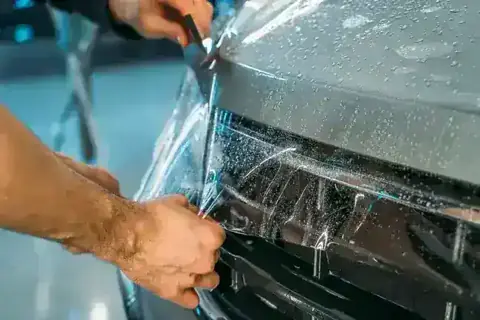
A PPF paint protection film 150-200 microns thick physically absorbs the hits. The scratch stays on the film, not on the paint. Self-healing variants pull minor scratches back together under heat (sun, hair dryer, warm water). Wrapping the front group (bonnet, bumper, fenders, headlights) is typically a day in the studio and 10 years of protection from most scratches.

The logic: if you polish yearly because of new scratches in the same spots, PPF pays off in 3-4 years. If scratches are random and rare (every 2-3 years), polishing on demand is simpler.

Prices for scratch removal — comparison

For a Tbilisi reference:

  • Level 1 polishing (everyday web) — from 690 ₾ for the whole body. Single panel — from 150 ₾ with inspection.
  • Level 2 polishing (medium scratches) — from 690 ₾, possible surcharge for multi-stage work.
  • Level 3 local scratch repair — quoted directly by a body shop, depending on colour and match difficulty.
  • PPF on the front group — materially higher, but 10-year protection. Pricing on the PPF film page.

Full pricing with details on service pages. Final figure after LED-lamp inspection.

FAQ

Can a scratch be removed with retail polish cream?

Only a level 1 scratch — in the clear coat. The shop-bought cream fills the groove with wax and the scratch becomes invisible for 2-6 weeks. After a wash or rain, it returns. For levels 2 and 3 cream is useless — it doesn't remove clear coat and doesn't fix the defect.

How many drives after polishing before new scratches appear?

Depends on conditions. Hand wash every 10 days, garage parking — new scratches effectively don't show for 2-3 years. Brush car wash weekly — a new "web" in 2-3 months. Out-of-town drives on gravel roads — new chips and scratches after every trip. The best strategy is to remove the causes (good wash, right chemistry) or protect the clearcoat (ceramic, PPF).

Are all level 2 scratches polishable?

Not all. If a scratch is very deep (through 80-90% of clear-coat thickness and nicking the base), fully removing it requires taking off all clear-coat — already a critical thinning. In such cases polishing makes the scratch less visible but doesn't fully remove it. Honest shop caveat: "we'll get 70-80% out, fully — only local touch-up."

What does local repair of a single level 3 scratch cost in Tbilisi?

From 300 to 600 ₾ for a 5-10 cm scratch. Price depends on colour-match complexity (simple white, black — closer to 300 ₾; pearl, multi-pigment metallic — closer to 600 ₾) and work time. After repair, panel-level polishing is usually needed — quoted as a separate line on the polishing price list.

Will scratches appear on PPF film?

Yes, with two caveats. First — most premium films are self-healing: minor scratches pull themselves back together under heat. Second — if the scratch is deep (down to the paint under the film), self-healing won't remove it. But unlike paint, film can be locally replaced — a single element (bumper, fender) costs materially less than a repaint.

Conclusion

Scratches come in three depth levels, each treated by its own method. Level 1 (in clear coat) — finishing polish in an hour. Level 2 (to base) — multi-stage polish with thickness control. Level 3 (to primer or metal) — local repair with touch-up, not polishing.

Nail test + side lighting + loupe in 5 minutes sets the level. Most everyday scratches — levels 1-2, removed by polishing from 690 ₾ for the body. Deep single scratches go to local body-shop repair at that shop's own rate. If scratches appear permanently in the same spots, covering those zones with PPF film makes sense.

Key takeaways:

  • Level 1 scratch (in clear coat) comes out with finishing polish; 60-70% of everyday cases
  • Level 2 scratch (to base) needs multi-stage polishing with thickness control
  • Level 3 scratch (to primer) — local repair with touch-up, not polishing
  • Nail test + side lighting in 5 minutes determine the level
  • If scratches appear regularly, PPF on impact zones pays off in 3-4 years

Book body polishing at BESTAUTO via the service page form or by phone:

  • BESTAUTO Guramishvili — Guramishvili Ave. 78, tel. +995 550 000 299
  • BESTAUTO Politkovskaya — Anna Politkovskaya St. 51, tel. +995 550 000 199

Both studios operate Monday to Saturday, 10:00–20:00 in Tbilisi, Georgia. Before the procedure — an in-person inspection under LED: the technician classifies each scratch and says what polishing will resolve and what should go to local repair.

Google Reviews
4.8 ★★★★★ (197)
View all reviews on Google
Why Choose Our Detailing Center?
You'll love the result
  • 5 Years of Detailing Experience
    Professional wrapping of hundreds of cars of different makes and models
  • 2 Studios in Tbilisi
    Guramishvili 78 and Anna Politkovskaya 51 — choose a convenient location
  • 2,000 Satisfied Clients
    Hundreds of reviews, 4.9★ rating on Google
  • 10-Year Film Warranty
    We cover peeling, yellowing, and material defects

Order professional polishing

Our detailing studio will handle your task with quality

Book a consultation

Choose the nearest studio
for a free consultation

Free inspection, pre-consultation and booking for main services available at both locations

BESTAUTO Guramishvili
Tbilisi, Guramishvili Ave. 78
BESTAUTO Guramishvili

Tbilisi, Guramishvili Ave. 78

+995 550 000 299
Mon–Sat 10:00 – 20:00
Enter phone in international format: +995 5XX XXX XXX
Request sent!
We will call you back within 15 minutes.
Or call us: +995 550 000 299
BESTAUTO Saburtalo
Tbilisi, Anna Politkovskaya St. 51
BESTAUTO Saburtalo

Tbilisi, Anna Politkovskaya St. 51

+995 550 000 199
Mon–Sat 10:00 – 20:00
Enter phone in international format: +995 5XX XXX XXX
Request sent!
We will call you back within 15 minutes.
Or call us: +995 550 000 199
Chat on WhatsApp
Choose your studio
Guramishvili Studio
78 Guramishvili St
Saburtalo Studio
51 Anna Politkovskaya St
Book a Free Inspection