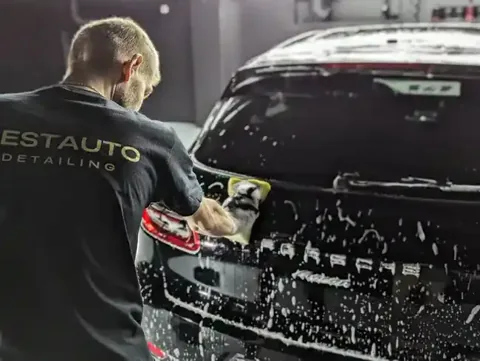
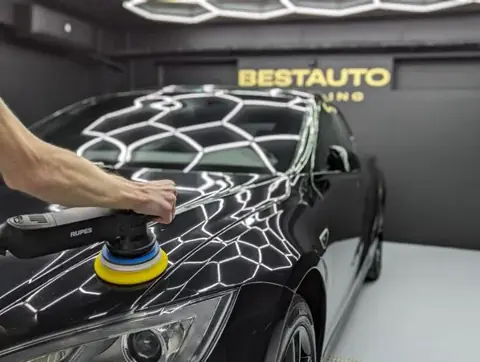
Highly recommend! Professional staff, flawless detailing, and my car has never looked better
A musty smell inside a car rarely appears suddenly. Usually a chain leads to it: water passed through a door sill after a wash, leaves blocked the AC drain, a weather strip under the windshield let rainwater in. Foam under a mat or under a seat retains moisture for weeks, and after three to five days in a warm cabin, mold starts to grow. The car looks normal from the outside; inside it carries a sharp, sour, distinctive odour no air freshener can mask. Below — how a detailing studio finds the source of moisture, how dry cleaning with ozone differs from "we just washed the seats", and why mold in a cabin returns a month later if the root cause is not fixed.
Where mold comes from: three common sources in Tbilisi, Georgia
First — leakage through a weather strip. Rubber around doors, windshield and rear glass loses elasticity over time. In Tbilisi, Georgia the process is accelerated — summer heat dries plastic at up to 55°C, winter cold cracks it. Water from car washes and rain enters through the gap and runs down the inner trim into the foam of the floor carpet. Nothing is visible from the outside, but a soaked underlayer forms inside.
Second — blocked AC drain. An air-conditioner has a tube for condensate drainage under the vehicle. If leaves, poplar fluff or road debris enter it, water starts dripping into the cabin through the evaporator. The classic symptom is a puddle under the front passenger mat, most often in summer when the AC runs hard.
Third — forgotten window or open sunroof. A storm rolled in, the car was parked outside, water hit the seats and soaked into the fabric. The source is obvious here, but the scale of wetness is often underestimated: the top layer of fabric dries within a day, the foam beneath holds water for 7-14 days.
In all three scenarios the problem is not the visible wet surface but the hidden foam. Without finding and drying it, dry cleaning only works for a week — then the smell returns.
Stage 1. Diagnostics — without it, dry cleaning is pointless
At BESTAUTO the first stage for a "musty smell" request is diagnostics, not straight to cleaning. The technician pulls mats, slides front seats back, lifts the fabric underlayer along the seams, and checks the foam by hand — dry or wet. In parallel the AC drain tube is blown out with compressed air, the door and windshield seals are inspected, and the plastic sill trims come off.
If the foam is wet, the source is traced by the direction of soaking: from the wettest spot — toward the potential water entry. Non-obvious findings come up often — a 2 cm tear in the windshield seal that leaks up to half a litre per hour in a heavy rain, for example. Without that find, any dry cleaning is temporary: the upholstery dries, but water starts coming back with the first rain.
Diagnostics take 20-40 minutes and are included in the free pre-procedure inspection. The client gets a clear answer: "it leaks here, fix the seal first, then clean" or "source is already resolved, heavy category plus ozone is the right call".
Stage 2. Disassembly and water extraction from the foam
After diagnostics, and once the source is fixed (or being fixed in parallel), deep cleaning starts. It differs from a standard dry clean precisely by disassembly — mats out, front seats fully removed, fabric floor underlayer peeled back, inspected, and if critically soaked — dried separately with an industrial heater.
The key tool here is a rotary extractor. Unlike a regular vacuum, it injects clean water with detergent under pressure into the foam and immediately pulls it back together with microflora and soil. 4-6 passes per seat, 6-8 on floor carpet — until the extracted water runs clear. For harder cases an enzymatic cleaner is used: it breaks biological odour molecules at the protein level rather than just rinsing them away.
In parallel, 150°C steam passes over plastic, vents and armrests — it disinfects without extra chemistry and dissolves the grease where fungi and bacteria live.
Stage 3. Ozone treatment — mandatory step for mold
Dry cleaning removes visible dirt and most microflora from the fibres. But mold is not only what is on the surface — it is also spores that penetrate the foam deeper than the cleaning reaches. Leave them in, and the colony recovers in 2-3 weeks the next time moisture returns.
Ozone treatment solves this. The generator runs in a sealed cabin for 30-40 minutes. Ozone (O₃) is an unstable gas — it reaches every crevice, breaks cell walls of microorganisms, and splits odour molecules at the chemical-bond level. After the procedure, a mandatory 30-minute venting. The cabin ends up with neither mold nor ozone smell.
Ozone is 50 ₾ on top of any dry cleaning category. For post-leak cases it is not just recommended — taking on the job without it makes no sense, the client returns in a week with the same smell. More on the procedure in the breakdown of cabin ozone disinfection.
Stage 4. Drying — where studios cut corners most often
After extraction and ozone, the cabin remains damp to the touch. Handing the car over in that state means mold returns in 24-48 hours — damp foam in a warm sealed cabin is an ideal environment. That is why a long warm-air dry is mandatory after wet work: a heater in the cabin for 8-12 hours, all doors open, windows cracked.
In Tbilisi winter this stage adds 4-6 hours on top of the summer norm. Summer is easier — evaporation is faster. Either way, a heavy-category clean after water damage is not "drop off morning, pick up evening" — it is "drop off evening, pick up next day", often overnight in a heated bay.
Inexperienced studios cut this stage short — they release the car early because "everything looks dry". A week later the client returns with smell and mold. In a professional studio, drying is controlled by actual upholstery moisture, not by the clock.
How much it costs and how long it takes
On the BESTAUTO price list this lands in medium or heavy category plus ozone:
- Medium soiling — from 500 ₾ (source localised, foam wet in one zone)
- Heavy soiling — from 550 ₾ (half of cabin soaked, persistent odour)
- Ozone — from 50 ₾ (mandatory for mold)
Current pricing for every category is on the interior cleaning service page. Final figure is set at the in-person inspection after the technician has checked the scope of soaking and found the source.
Timeline: diagnostics 20-40 minutes, disassembly and extraction 4-6 hours, ozone 1 hour, drying 8-12 hours. In practice this means evening drop-off and next-day pickup by lunchtime. Winter adds another 4-6 hours.
Prevention — so you don't come back in six months
Mold is a consequence, not a cause. Fix the water source and dry cleaning holds for years. Baseline prevention in Tbilisi:
Weather strip inspection every autumn, before rain season. Rubber is checked for elasticity (finger pressure should leave a mark that quickly recovers) and for cracks at corners. Problem strips are replaced before the first heavy rain, not after.
AC drain cleaning in spring, before active AC use. The tube gets blown out with compressed air; the protective mesh comes off and gets cleaned of leaves. Ten minutes at any regular service shop.
Mat drying after every wash. Rubber mats out and shaken, fabric ones vacuumed. Moisture that migrates from mats into floor foam is one of the most underestimated causes of hidden soaking.
After a heavy rain or wash — a slightly open window when the car is in a garage or under a roof. It reduces cabin humidity by 20-30% overnight and stops condensation from settling on upholstery.
FAQ
How much does it cost to remove mold from a car cabin?
From 500 ₾ for medium soiling plus 50 ₾ for ozone, so from 550 ₾. Heavy soaking — from 600 ₾. Final figure is set at the in-person inspection based on the scope of soaking and the source location. Full pricing by category is on the interior cleaning service page.
Can I just do ozone without dry cleaning?
No. Ozone kills surface smell and microflora, but it does not pull fungi out of water-soaked foam. In 2-3 weeks the colony recovers and the smell returns. Ozone only works paired with wet extraction that physically flushes microflora out of fibre depth. Ozone on its own is a wasted 50 ₾.
What if the water source isn't found at inspection?
Then the procedure gets postponed. Dry cleaning without fixing the root cause is temporary — the leak will recur in a month and mold will return. In that situation the technician recommends a hydrotest (high-pressure water applied to the car in a bay) at a body-repair specialist first, finding the entry point, fixing it — and only then booking the clean.
How soon after a leak should cleaning start?
The sooner, the cheaper. First 48 hours — wetting is surface-limited, medium category works without ozone. After 3-5 days in a warm cabin, mold is already growing, heavy category plus ozone is needed. After 2-3 weeks, part of the floor sound insulation often has to be replaced — that is body-shop work already.
Does the smell come back after proper dry cleaning with ozone?
With proper procedure (diagnostics, source fix, extraction, ozone, long drying) — no. The result holds 6-12 months without return. If smell comes back in 2-4 weeks — the water source was not resolved or drying was cut short. That is a warranty case, not a reason to pay for another clean.
Conclusion
Mold in a cabin is an indicator of hidden water damage, not a cosmetic issue. Dry cleaning removes smell and microflora, but without diagnostics and source fix the effect holds for weeks. The correct sequence in Tbilisi is one: find the water entry, close it, disassemble the cabin, extract moisture from foam, run ozone, dry in a heated bay for 8-12 hours. Only then does the car leave the studio in a state that holds for a year and more.
Key takeaways:
- Cabin mold is always a consequence of hidden moisture in the foam; surface dries fast, underlayer takes weeks
- Source diagnostics is stage one — without it, cleaning works for a week
- Dry cleaning with mold — medium or heavy category (from 500 ₾) plus mandatory ozone (50 ₾)
- Drying 8-12 hours in a heated bay — the stage inexperienced studios cut most often
- Autumn seal inspection and spring AC drain cleaning cover 90% of recurrence scenarios
Book interior cleaning with ozone at BESTAUTO via the form on the service page or call whichever studio is convenient:
- BESTAUTO Guramishvili — Guramishvili Ave. 78, tel. +995 550 000 299
- BESTAUTO Politkovskaya — Anna Politkovskaya St. 51, tel. +995 550 000 199
Both studios are open Monday to Saturday, 10:00-20:00. A free in-person inspection with moisture source diagnostics precedes the procedure. Final figure is set after the inspection.