Mountain trip polishing — body check after Kazbegi/Svaneti

Kazbegi, Svaneti and the Georgian Military Road leave more marks on the body than a regular city year. What to inspect and when polishing is needed.

A mountain trip in Georgia is three to five days behind the wheel, a thousand kilometres of switchbacks, and a return to Tbilisi with a car carrying more wear than half a city year. Kazbegi, Ushguli, Mestia, the roads to Gergeti and Shatili all work the body from several directions at once: gravel flung up from oncoming cars, dust off gravel roads, branches on narrow sections, and in winter — road chemicals as well. Below: what to inspect on return, what a car polish will remove, and what stays in the paint permanently.

What actually damages the body on a mountain trip

A mountain road works the car in three ways, each leaving its own trace. First — fine gravel thrown up by oncoming vehicles. On the Georgian Military Road, especially the Pasanauri-Kobi stretch, a 2-3 mm stone hits the bumper and lower fenders every few minutes. The marks are not immediate: on light paint they are dots with no chip, on dark they are micro-craters that show as "spot haze" in sunlight.

Second — dust off gravel roads, and Svaneti has kilometres of it. At 40-60 km/h quartz particles literally sandblast the clearcoat. After a three-day trip the bonnet and A-pillars carry a "web" of marks — the same signature as a stiff-brush car wash, only denser.

Third — branches, when the road narrows to one lane and you brush past shrubs. Mirrors, sills, rear fenders catch long scratches. Some come off with a wash (if the mark is superficial), others stay in the clearcoat.

A separate story is winter driving. On the Jvari Pass and around Gudauri the winter chemicals are aggressive: a sodium and calcium chloride mix dries as a crust and eats the clearcoat in spots. If the car sits for a day after return without a wash, by spring dull haloes appear where the salt spray landed.

Post-trip inspection checklist

Check the car under good light — sunlight or an LED lamp at a service bay. A quick glance in a garage under a 60 W bulb shows nothing: clearcoat defects are only visible under directed light at an acute angle.

  • Front bumper and lower bonnet — gravel dots, small chips. Feel with a fingernail: is there a divot? If yes and the bottom is grey, it goes to primer — polishing won't fix it, a local paint repair is needed.
  • Front fenders around the wheel arches — the same dots plus gravel kicked up by the car's own wheels on dusty track.
  • Outer sills — branch and bush scratches from narrow passing sections.
  • Mirrors — side and edge, separately on the protective plastic. Plastic mirror housing scratches don't wash off.
  • Windshield A-pillars — small branches and insects at speed leave inclusions that etch in within two weeks if not cleaned off immediately.
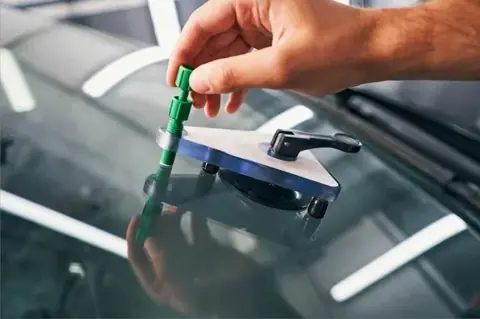
  • Windshield glass — stone chips. Inspect under sunlight facing the light. A 2-3 mm chip is repairable, over 30 mm means replacement.

A walk-around on a well-lit forecourt takes 10-15 minutes. If the car looks clean at a glance but a dull "web" appears on bonnet and fenders at a sharp angle — that's the dust talking, and polishing will take it out.

What studio polishing removes after scratches

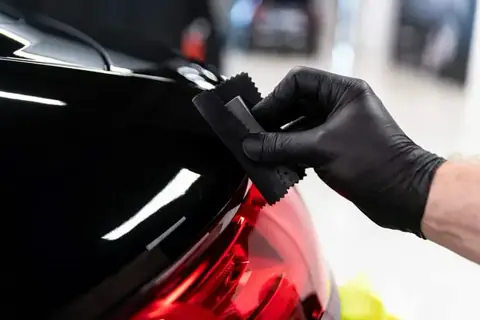
Car polishing after a mountain trip works on three defect types. First — surface "webbing" from dust, scratches within the top 2-3 microns of clearcoat. An abrasive compound on a machine removes an even layer and levels the surface. Second — micro-scratches from brushes and branches, if they stay within clearcoat thickness. Third — dull traces from dried-on salt and chemistry if the body wasn't washed in time.

What polishing will not fix: chips to primer, deep scratches you can feel with a fingernail, and cracks in the clearcoat from stone impact. These go past the layer the abrasive works with. They need localised paint repair (panel touch-up) or — as a future-proofing solution — a paint protection film on impact zones.

Process is standard: two-phase wash with degreaser, diagnosis under lamp with a thickness gauge, polish in two or three stages depending on condition. A mid-size sedan — 6-10 hours. A car with a scuffed "matte" surface after a long dusty trip — closer to a full day.

Polishing prices after a mountain trip

BESTAUTO prices in Tbilisi are structured by surface type — convenient when a mountain trip has damaged the car unevenly: bonnet and bumper heavily, doors and roof moderately.

  • Body polishing — from 690 ₾
  • Headlight polishing — from 150 ₾ (needed after dust from gravel — in Svaneti the optics haze noticeably)
  • Interior element polishing — from 200 ₾
  • Glass polishing — from 250 ₾

The exact figure depends on what was hit. If it's only the bonnet and bumper — full-body polishing isn't needed, partial work on the front group is enough. If dust coated the whole body evenly — the whole body goes in. The technician gives the precise number after inspection under LED; the full price list is on the car polishing service page.

When polishing won't help: winter chemicals and chips to primer

Two scenarios where studio polishing is useless. First — winter chemicals have etched the clearcoat without a timely wash. If the car sat dirty for a week after Gudauri or the Jvari Pass, salt crossed the clearcoat and left dull patches at base-coat level. Polishing only takes such marks out if they haven't reached the base. If they have — only a repaint.

Second — gravel chips with primer damage. A 1-2 mm dot on the bumper where the bottom is grey metal or white primer is not a polishing defect. Such chips are treated locally: clean-up, degrease, fill with colour-matched paint and sand. Fifteen to twenty dots on an average bumper — an hour and a half of local repair, and only then does a general polish make sense.

How to reduce damage from the next mountain trip

Three measures work in practice. First — a wash right after return, ideally the same day. Salt, tar, dust, insects on the windshield — all of it comes off more easily in the first 24 hours before it bonds with the surface.

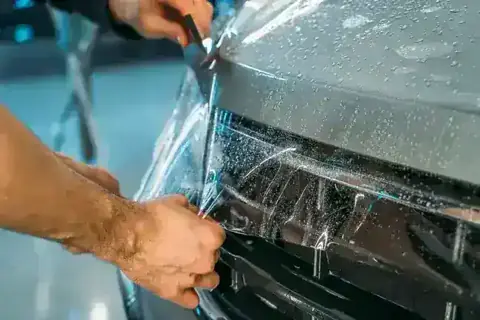
Second — protect vulnerable zones before the trip. Front bumper, bonnet and front fenders take 80% of gravel hits. A PPF paint protection film 150-200 microns thick physically covers the clearcoat: a stone leaves a mark on the film, not on the paint. Unlike ceramic coating, which works at the level of chemistry and UV, PPF is a physical barrier. Wrapping a single bonnet and bumper takes a day in the studio and removes the worst gravel threat on future trips.

Third — scheduled polishing every 12-18 months, to prevent fine scratches accumulating into general clearcoat haze. With ceramic on top, a polish holds longer and the body is easier to wash.

FAQ

Is polishing needed after a single trip to Kazbegi?

Depends on the trip. One day on the Georgian Military Road with normal traffic — usually no, a good wash is enough. Three to five days with overnights and gravel runs to Juta or Gergeti — likely yes, especially on dark paint. The call is made by a light inspection: if the "web" shows on bonnet and fenders under sunlight, polishing will help.

Can polishing be postponed to the end of the season if two or three more trips are planned?

It can, and often it's sensible. If two more mountain runs are planned this month, one polish at the end of the season beats three in a row with short breaks. With a caveat: a wash after every trip is mandatory — otherwise accumulated dirt and salt keep working on the clearcoat and by season's end not all defects can be polished out.

Will ceramic coating protect from gravel in the mountains?

No. Ceramic works at the level of chemistry (easier washing, UV and stain protection) and doesn't take physical impact. A 3 mm stone at 80 km/h will leave a mark on clearcoat with ceramic the same as without. Only PPF film protects from gravel — a polyurethane coating 150-200 microns thick that physically shields impact zones.

What does polishing after a mountain trip cost in Tbilisi?

The base price for body polishing at BESTAUTO is from 690 ₾. After a mountain trip with moderate damage — usually in this range. If the car is badly affected (dust sandblasted the bonnet, salt in the clearcoat, web across the whole body) — the figure is higher and depends on body size and work depth. The precise number comes after an LED inspection; full pricing is on the car polishing page.

What to do with windshield chips after the mountains?

A small chip under 1 cm is repaired in 30-40 minutes with a resin injector. Up to 2 cm — also repairable, though the result is more visible. Over 30 cm or a crack across the glass — replacement. Repair price in Tbilisi from 60 ₾ for a small chip, from 140 ₾ for a crack up to 30 cm. Inspect the windshield on day one after return: if a chip is not sealed, the first frost or a sharp heat cycle will push it into a crack.

Conclusion

A mountain trip in Georgia always leaves more marks on the body than a regular city month. Gravel, dust off unpaved roads, branches on narrow sections and winter chemicals all work at once and leave layers of damage at various depths. The good news — most surface defects come off with studio polishing: the "web" from dust, micro-scratches from branches, dull traces from unwashed salt.

Serious damage — chips to primer, cracks in the clearcoat, winter salt in the base — is not a polishing job. These need localised repair, and for the future — protection of vulnerable zones with PPF. A common mistake is to drive the mountains without a protection plan and polish the car only once in two years: by the third season defects accumulate to the point where a regular polish won't cover them.

Key takeaways:

  • A mountain trip leaves more marks than a city month: gravel, dust, branches, winter chemicals
  • Inspection under directed light is needed within 1-2 days of return
  • Body polishing in Tbilisi from 690 ₾, headlights from 150 ₾, glass from 250 ₾
  • Chips to primer and clearcoat cracks are not a polishing fix — local repair only
  • Front-group PPF before the season removes 80% of future gravel problems

Book body polishing at BESTAUTO via the form on the service page or by phone:

  • BESTAUTO Guramishvili — Guramishvili Ave. 78, tel. +995 550 000 299
  • BESTAUTO Politkovskaya — Anna Politkovskaya St. 51, tel. +995 550 000 199

Both studios operate Monday to Saturday, 10:00–20:00 in Tbilisi, Georgia. Before polishing — a free in-person inspection: the technician views the body under LED, assesses defect depth, and decides whether a full polish is needed or work on the front group is enough.

Google Reviews
4.8 ★★★★★ (197)
View all reviews on Google
Why Choose Our Detailing Center?
You'll love the result
  • 5 Years of Detailing Experience
    Professional wrapping of hundreds of cars of different makes and models
  • 2 Studios in Tbilisi
    Guramishvili 78 and Anna Politkovskaya 51 — choose a convenient location
  • 2,000 Satisfied Clients
    Hundreds of reviews, 4.9★ rating on Google
  • 10-Year Film Warranty
    We cover peeling, yellowing, and material defects

Order professional polishing

Our detailing studio will handle your task with quality

Book a consultation

Choose the nearest studio
for a free consultation

Free inspection, pre-consultation and booking for main services available at both locations

BESTAUTO Guramishvili
Tbilisi, Guramishvili Ave. 78
BESTAUTO Guramishvili

Tbilisi, Guramishvili Ave. 78

+995 550 000 299
Mon–Sat 10:00 – 20:00
Request sent!
We will call you back within 15 minutes.
Or call us: +995 550 000 299
BESTAUTO Saburtalo
Tbilisi, Anna Politkovskaya St. 51
BESTAUTO Saburtalo

Tbilisi, Anna Politkovskaya St. 51

+995 550 000 199
Mon–Sat 10:00 – 20:00
Request sent!
We will call you back within 15 minutes.
Or call us: +995 550 000 199
Chat on WhatsApp
Choose your studio
Guramishvili Studio
78 Guramishvili St
Saburtalo Studio
51 Anna Politkovskaya St
Book a Free Inspection