How often to polish a car — myths debunked

"Every season," "more often = better," "any polish cream removes scratches." Where these ideas come from and what clearcoat physics says.

The question "how often to polish a car" has been debated on car forums for years, and the same ideas keep surfacing. "Every year, ideally twice," "the more often you polish, the better the condition," "I'll hit it with a bottle every quarter and it'll be like after a studio." All three claims are myths, and they share a cause: people mix two different operations (polish cream vs abrasive polishing) and ignore clearcoat physics. Point by point, let's see what holds and what doesn't.

Myth 1: "A car needs polishing every year"

The most common myth, partially inherited from early-2000s detailing studio marketing where polishing was positioned as a mandatory seasonal procedure. In practice frequency depends on three factors: car age, usage style, previous protection.

Real-world scenarios:

  • New car (up to 2 years) — polishing usually not needed. Factory paint is fresh, no defects. A cream polish once a season for shine maintenance is enough.
  • 3-5 years, city use, hand wash — once every 2 years is the norm. Light swirls from washes appear, but clearcoat thickness still has a buffer.
  • 3-5 years, brush car wash — every 12-18 months. Brushes lay down a dense "web" per season; without polishing it accumulates.
  • 7+ years, any usage — mandatory, but not more often than every 2 years, or you'll hit the critical minimum thickness (80 microns) fast.

"Every year" is an average without case specifics. For a 3-year-old car that stays in a garage and gets hand-washed, yearly polishing is wasted money and unnecessary clearcoat removal. For a 7-year-old car washed at an automatic bay, polishing every 2 years is the minimum — otherwise the clearcoat degrades faster than it recovers.

Myth 2: "The more often you polish, the better the condition"

A myth, and a dangerous one. Clearcoat physics is strict: every full studio polish removes 2-5 microns of clearcoat. Factory thickness is usually 100-150 microns. Below 80 microns abrasive polishing of that panel becomes risky, below that — impossible. Simple math: 150 microns of factory clearcoat minus 80 critical = 70 microns of buffer = 14-35 full polishes across the car's lifespan.

A car polished every six months hits critical minimum in 7-10 years — about when many cars just enter the used market. From there: repaint, or live with what's left, no ability to remove new defects with abrasive polishing.

Polishing "just in case" with no visible defects is a classic emotional-sell approach — "I want it to shine" — and burns precious clearcoat. The right approach:

  • Before polishing, the technician measures clearcoat thickness with a gauge
  • If buffer is below 100 microns, polishing is skipped
  • On panels with 80-100-micron buffer, only chemical polish without abrasive
  • Abrasive polishing — only by actual condition (visible defects, holograms, haze), not by schedule

At BESTAUTO, clearcoat thickness is measured before every procedure — client safety and protection from "make it shine at any cost."

Myth 3: "A bottle of polish equals polishing"

The most frequent myth, built on the same word on the package. A supermarket cream polish (a few lari per bottle) and studio polishing at 690 ₾ aren't just different procedures — they are physically different operations:

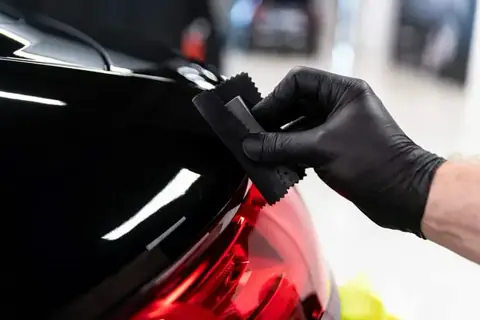
  • Polish cream — wax formulation with silicone and fillers. Doesn't remove clearcoat physically, fills micro-cracks and masks them. Lasts 2-6 weeks.
  • Abrasive polishing — compound with micro-grain on a machine, physically removes the top clearcoat layer along with defects in it. Lasts 6-12 months.

Someone who "polishes the car every quarter with a bottle" isn't polishing — they're applying wax cream. The result: the car shines for a couple of weeks after application, but all deep defects accumulate. Then at one studio polish the technician finds a neglected body and has to remove more layer in one go.

Cream polish is useful between studio procedures, but doesn't replace them. Once or twice a season is fine as maintenance. As maintenance — not as the main care method.

What actually drives polishing frequency

Stripping out the myths, frequency is set by four real factors:

  • Clearcoat thickness buffer. Measured with a gauge on each panel. Below 100 microns — polishing is postponed.
  • Visible defects. Wash swirl web, holograms, haze, matte patches. Present — polish is needed; absent — it isn't.
  • Planned protection. Before ceramic or PPF, polishing is mandatory; on a schedule — no.
  • Wash style. Hand wash with pH-neutral shampoo — every 2-3 years. Brush automatic — every year to 18 months.

Thickness measurement is 10 minutes in the studio and the key factor. Without it the technician works blind and risks crossing the safe threshold. A professional polishing studio always starts with a gauge.

The alternative to frequent polishing — protection

A common pattern: an owner in Tbilisi, Georgia drives around, washes the car weekly at a brush station near a petrol stop, collects new scratches, and decides to "polish once a year." Over 10 years on that schedule the clearcoat is spent.

The answer isn't frequent polishing — it's protection between polishes. Three working approaches:

  • Hand wash — eliminates 80% of the cause of swirls. Every 10 days, pH-neutral shampoo, two-bucket method, microfibre.
  • ceramic coating — hydrophobic effect, easier washes, tar and bird droppings bond less. Lasts 2-3 years.
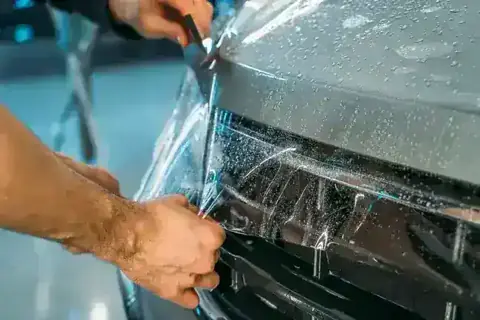
  • PPF paint protection film — physically absorbs gravel hits. On impact zones (bonnet, bumper, fenders) it gives 10 years of defence against new chips.

With PPF on the front group and ceramic on top, polishing is needed every 3-4 years — new defects simply don't appear. That's cheaper in the long run than polishing every year.

Polishing prices in Tbilisi

For reference, to avoid going by "something from the internet":

  • Body polishing — from 690 ₾
  • Headlight polishing — from 150 ₾
  • Interior element polishing — from 200 ₾
  • Glass polishing — from 250 ₾

One full procedure at BESTAUTO. Full price list with details — on the car polishing page; final price is set at the in-person inspection with clearcoat thickness measurement.

FAQ

How often to polish the car if it sits in a garage and is rarely washed?

With minimal use — every 2-3 years, by actual defect appearance. A cream polish once a season is enough to maintain shine. A car permanently in a garage washed 1-2 times a month by hand may only need abrasive polishing every 3-4 years.

Can the car be polished more often if I use cream polish in between?

Cream polish isn't polishing and doesn't consume clearcoat. It can be used monthly — it works as shine maintenance. But studio (abrasive) polishing stays strictly scheduled once every 1-3 years depending on condition. More frequent than that damages the clearcoat.

How many full polishes can be done across a car's life?

Theoretical max — 14-35 procedures, assuming 150 microns factory clearcoat and 2-5 microns per procedure. Practical minimum for typical 10-year usage — 4-6 procedures. More than 7-8 studio polishes across a car's life risks hitting the limit on at least one panel.

Why does the technician measure clearcoat thickness before polishing?

To stay under the threshold. The gauge shows how much clearcoat is left on a specific panel. If a panel shows 90 microns (e.g. after previous polishes or body repair) — abrasive polishing on it is skipped. A technician without a gauge is either lazy or inexperienced. At BESTAUTO, measurement is mandatory.

What happens if I polish the car every six months?

Over 4-5 years on that schedule, most panels' clearcoat buffer drops into the critical 80-micron zone. After that, any new polishing is impossible without a repaint. This risk is rarely discussed in practice, but it's real — clearcoat is a finite resource.

Conclusion

Polishing frequency isn't a schedule, it's a function of condition. Myths about "once a year" or "more often = better" ignore clearcoat physics: every full polish removes 2-5 microns, and the buffer is finite. The real norm for a typical city car — once every 2-3 years, by actual defect appearance, not by calendar.

Three myths worth dropping: "every year mandatory," "more = better," "bottle = polishing." All three stem from mixing operations (cream vs abrasive) and underestimating physics. It's smarter to work on protection between polishes (hand wash, ceramic, PPF on impact zones) than to burn clearcoat on a schedule.

Key takeaways:

  • polishing every year is a myth; norm is once every 2-3 years for a typical car
  • Each polish removes 2-5 microns of clearcoat; total budget is 14-35 procedures
  • Retail cream polish isn't polishing and doesn't consume clearcoat
  • The answer is protection between polishes (ceramic, PPF), not frequent polishing
  • A thickness gauge before the procedure is mandatory; without it, damage risk is real

Book car polishing at BESTAUTO via the service page form or by phone:

  • BESTAUTO Guramishvili — Guramishvili Ave. 78, tel. +995 550 000 299
  • BESTAUTO Politkovskaya — Anna Politkovskaya St. 51, tel. +995 550 000 199

Both studios operate Monday to Saturday, 10:00–20:00 in Tbilisi, Georgia. Before the procedure — a free in-person inspection with clearcoat thickness measurement. Based on the results, the technician decides whether abrasive polishing is needed or a chemical polish will do.

Google Reviews
4.8 ★★★★★ (197)
View all reviews on Google
Why Choose Our Detailing Center?
You'll love the result
  • 5 Years of Detailing Experience
    Professional wrapping of hundreds of cars of different makes and models
  • 2 Studios in Tbilisi
    Guramishvili 78 and Anna Politkovskaya 51 — choose a convenient location
  • 2,000 Satisfied Clients
    Hundreds of reviews, 4.9★ rating on Google
  • 10-Year Film Warranty
    We cover peeling, yellowing, and material defects

Order professional polishing

Our detailing studio will handle your task with quality

Book a consultation

Choose the nearest studio
for a free consultation

Free inspection, pre-consultation and booking for main services available at both locations

BESTAUTO Guramishvili
Tbilisi, Guramishvili Ave. 78
BESTAUTO Guramishvili

Tbilisi, Guramishvili Ave. 78

+995 550 000 299
Mon–Sat 10:00 – 20:00
Request sent!
We will call you back within 15 minutes.
Or call us: +995 550 000 299
BESTAUTO Saburtalo
Tbilisi, Anna Politkovskaya St. 51
BESTAUTO Saburtalo

Tbilisi, Anna Politkovskaya St. 51

+995 550 000 199
Mon–Sat 10:00 – 20:00
Request sent!
We will call you back within 15 minutes.
Or call us: +995 550 000 199
Chat on WhatsApp
Choose your studio
Guramishvili Studio
78 Guramishvili St
Saburtalo Studio
51 Anna Politkovskaya St
Book a Free Inspection